Here's a recipe for a Can't-Miss "Great Hollywood Film" - 1.) take an original screenplay from Cormac McCarthy, the author of such hallmarks of recent American literature as "The Road," "Blood Meridian" and "The Sunset Limited." 2.) Get epic-master Ridley Scott, the director of such crowd-pleasers as Gladiator, Alien and Blade Runner to direct. 3.) Assemble an all-star cast consisting of Oscar winners and nominees like Michael Fassbender, Javier Bardem, Penelope Cruz, Cameron Diaz and Brad Pitt to bring the story to life. Your result from mixing all these ingredients will without a doubt get you one of the greatest films ever made, no matter what they turn out, right? Right? Well...
I watched The Counselor around 8:00 on a Sunday evening, and I am writing this review about eighteen hours later. I watched the unrated, extended home video edit of the film, not the version that played in theaters last fall and was so savaged by critics and what few moviegoers paid to see it. I watched it without distraction and without interruption, so as to assure my full attention be devoted to it. As a result, I have suffered a mostly-sleepless night afterward, having the reprehensible things depicted in this movie invade my dreams and keep me awake for a lot longer than a more enjoyable movie would. I have struggled to decide just what I think, or more simply, how I even feel, about this film. I’m still struggling, but perhaps crafting this essay will help me decide just what my final opinion should be.
The Counselor weaves a tale (or tries to) of the titular El Paso lawyer (Fassbender), who is never referred to by any name other than “Counselor,” planning on making some sort of drug deal with a powerful, shadowy Mexican cartel; a one-time occurrence that will theoretically set up him and his bride-to-be (Penelope Cruz) financially for life. Since he can only afford to fly to Amsterdam and buy a 3-carat stone for her engagement ring, he apparently needs the money something fierce. He works with a fairly successful drug-dealer acquaintance (Bardem) and a middleman connection to the cartel (Pitt) to make a sale to dealers in Chicago. Through a series of double-crosses and mistaken assumptions, the Counselor quickly finds just how incredibly naive he has been, how hopeless his predicament is, and how many people will suffer the consequences of his decisions.
The plot, as much of one as there is, is fairly simple, and mostly unnecessary, as the bare-bones story structure is mostly a means to provide these characters opportunities to have McCarthy-esque philosophical conversations with one another, so I’ll spare you any deeper summarization than that. Save for a few minor action/violence scenes to bridge scenes of dialogue, the film flows more like one of McCarthy’s stage plays, with a great number of scenes consisting primarily of two characters talking at great length. Of course, there is that much-talked-about scene with Cameron Diaz doing… oh, how shall I say it?... gynecologically immoral things to the windscreen of a Ferrari, but even that scene is a talking scene, a flashback playing over Javier Bardem’s character talking about the event to the Counselor.
Cormac McCarthy always populates his stories with morally bankrupt figures, and he may have surpassed his quota here. There are no redeemable characters to be found anywhere in this film, save for the Counselor’s poor fiancee’, although one might could claim the level of her innocence/naivete’ is almost so pathetically great that she deserves what she gets, too. Cameron Diaz’ portrayal of the cheetah-spot tattooed, cheetah-keeping girlfriend/business manager Malkina is so vampy that it’s either a brilliant acting choice or her acknowledging the absurdity of the character, but I’m not sure which. Even Brad Pitt is not stretching his acting chops much, as he seems to be pretty much playing the same character he portrayed in Thelma & Louise twenty-two years earlier, but perhaps twenty-two years older, and in the only place in life that character could’ve ended up. Fassbender and Bardem, however, do a credible job, Bardem in particular chewing the scenery enough to convey his character’s feelings of inferiority when next to the sexually and intellectually superior Malkina.
I can’t imagine that any of Cormac McCarthy’s written work would translate word-for-word to an audible presentation in any conversationally believable manner. Now, I’ve never heard any of his works in audiobook form, so I suppose I can’t rule out that medium as a possible mean of enjoying his complex dialogue, but there is a reason that (until now) he has never penned the screenplay for any of his other works adapted to film. Sure, previous movies based on his books are notable for characters waxing philosophic in rather dreary/poetic ways (think Tommy Lee Jones in No Country for Old Men or Matt Damon in All the Pretty Horses), but the screenwriters of those films did a pretty reasonable job of following the Less-is-More rule. The Counselor, being straight from Cormac McCarthy’s own hand, has no such filter, and for whatever reason, it seems Ridley Scott decided to film every bleepin’ word McCarthy wrote. For example, Ruben Blades is in only one scene of the movie, speaking to the Counselor over the phone, giving a lengthy Hispanic/New Age-ish existential assessment of the Counselor’s situation, ending by quoting some obscure Mexican poet at length, (literally) driving the Counselor to tears. Hell, it almost drove ME to tears.
Avarice seems to be the focal point of whatever moral lesson the film wishes to teach. All of these characters are fabuloulsly wealthy by most any rational person’s definition of the word, yet all of the poor decisions, shady dealings and violent acts the characters exhibit are in pursuit of even greater riches. The drug trade is the means to that end in this movie, but we never see any drug deals or (with one very brief exception) even any drug use. There isn’t anything one could construe as a just ending for any of the characters here, so Scott or McCarthy certainly didn’t have any notions of delivering any sort of emotionally satisfying experience to an audience. It seems their only definition of success they possibly could have hoped to achieve was to deliver a blistering morality tale about the inevitable outcome of unchecked greed, and on that level, I suppose I must grant that they did succeed.
In the interest of full disclosure, I remind you that Ridley Scott is one of my all-time favorite filmmakers, so take my views on his work with whatever grains of salt you wish. His work the last ten years has been spotty, as I acknowledge that his last great work was probably Kingdom of Heaven (and even the theatrical release of that film had structural problems; it was his Director’s Cut that made it to home video that restored lots of excised footage and produced a wonderful film). Each of his films since, with the possible exception of A Good Year, has had script or story structure problems, probably culminating with how almost-incomprehensible Prometheus turned out to be. He continues to be the consummate visual artist he has always been, however. I challenge anyone to deny ALL of his films are visual feasts, and The Counselor is no exception, but I wonder why it seems he cannot identify weak screenplays as he advances in years. There are so many scenes and characters in the Blu-ray version of this movie that serve absolutely no purpose in driving the narrative that I wonder how much Scott’s long-time editor Pietro Scalia was actually in the cutting room during post-production. Malkina’s visit to a confessional to tease a priest and a scene with John Leguizamo and Dean Norris discussing bodies in barrels are just two such scenes that should have been the first to go.
Did I like The Counselor? I don’t think this movie is really meant to be “liked.” It is possible that it is meant to be admired, or even respected. In the end, it seemed to me that Scott and McCarthy were more intent on illustrating how God laughs at us when we make plans than they were on providing us a tale of redemption from evil or growth from baser desires. I suppose it is a testament to Scott’s power as a filmmaker that, even in his mid-seventies, he still has the sway to get such a film financed, attract such a cast and get such a story on film despite its obvious shortcomings.
I can say positive things about the stellar cast and how wonderful a job they all did with what they were given to do. I can rave about Scott’s gorgeous use of the desert landscapes and corresponding color palettes to make yet another visually luscious film. I can’t see how I could bring myself to say I liked it, however. As a fan of Ridley Scott, I’m glad I saw it, but I don’t think I’ll be making a point of watching it again. I’ve lost enough sleep over it already.

 If Assassin’s Creed had been made as a period piece, with Aguilar as the hero, it may well have worked as a kind of heightened period epic – something like 300 meets Kingdom of Heaven. The movie’s best sequences are the Spanish Inquisition-set action scenes, inventively choreographed and beauti-fully executed. The game-inspired brand of wushu-meets-parkour in these scenes delivers some genuinely awe-inducing feats - a mid-carriage-chase wall-flip and a dead-eye ricochet shot wowed me, and helped to partially compensate for the dramatic lulls. The period production design and the thundering score by Kurzel’s brother Jed are better than the movie deserves, but even these sequences could have fared better, as Kurzel falls prey to the hyper-editing and spasmic-camera movements that so many action movies seem to suffer from anymore.
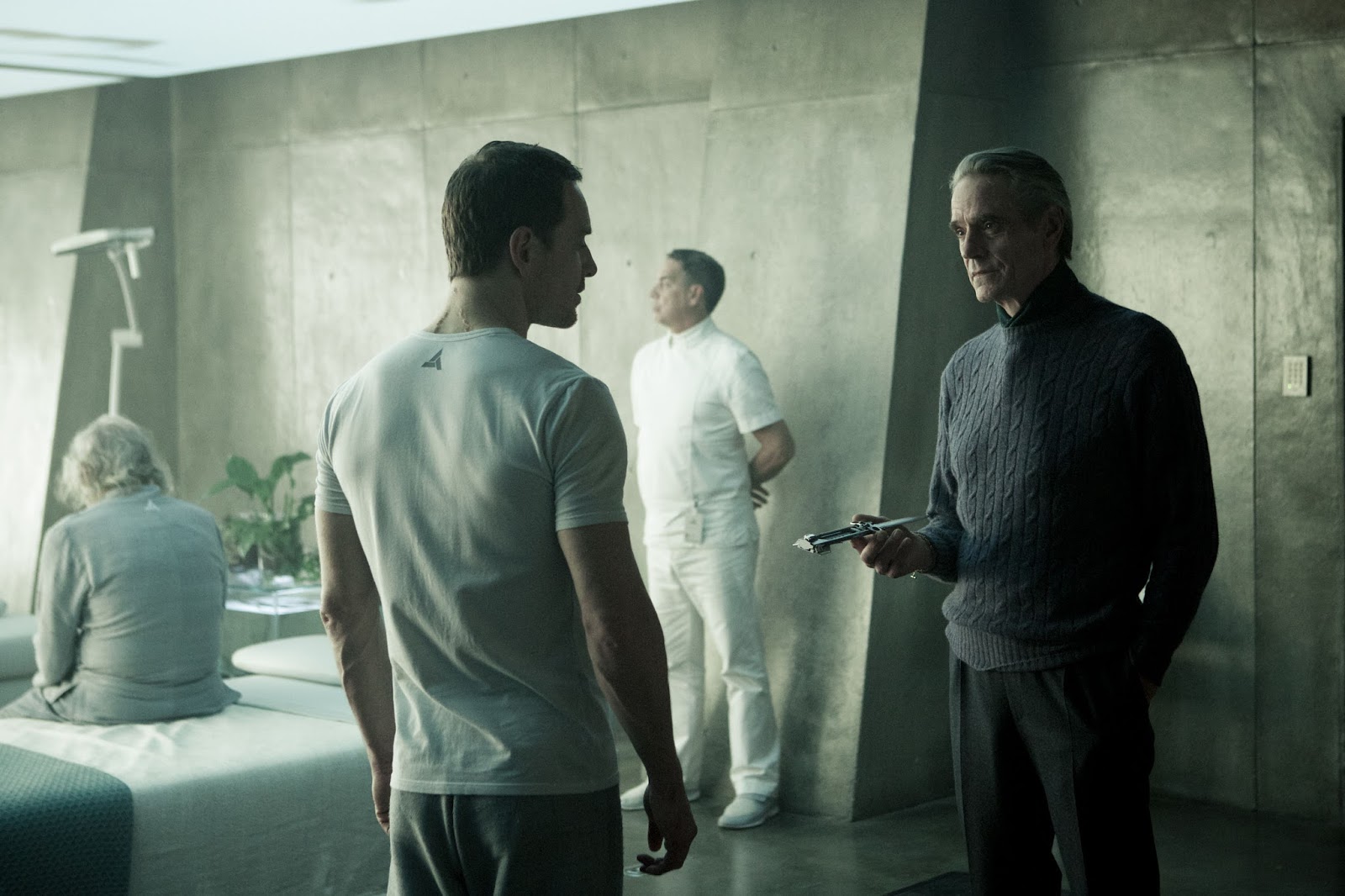 Sadly, we only spend three all-too-brief sequences in that period, with the rest of the film being stuck in this murky-blue antiseptic scien-tific facility where everyone has that slit-eyed counten-ance that ensures you know they’re up to no good. Fassbender is a dour, dull hero in both temporal spheres, and Cotillard and Irons both seem to just float through their roles, with an apparent lack of interest that I couldn’t tell was an acting choice or actual boredom on their part. The cast aren’t aided by the humorlessness of the screenplay, which treats all this hooey with a degree of seriousness that makes it all the more ludicrous. Even possibly interesting secondary characters get the short end of the screenplay - Charlotte Rampling, another distinguished actor, pops up briefly as the Templars’ head modern head honcho, but has a criminally minimal amount of screen time.
