Showing posts with label thriller. Show all posts

Sunday, July 29, 2018

"Mission: Impossible - Fallout" is Great Summer Fun, Just Nothing New

My dear mother, who has never seen any of the films in the Mission: Impossible series, asked me the day before I went to see Mission: Impossible - Fallout if I thought she’d like any of the earlier movies.  I told her that, at the risk of jinxing the new film, I’d say that the M:I series was possibly the only more-than-three film franchise of which I could think in which each new movie was better than the one that came before it.  Fast forward to the next evening, and as I’m sitting in a theater waiting for Fallout to begin, that word “jinx” creeps back into my mind. I wonder if, without realizing it, I’ve just placed an undeserved burden on the movie I’m about to see.  Nah, I think to myself - it’ll be great. Well...

Mission: Impossible - Fallout is a pretty darn good action movie.  That much is easy for me to tell you without any him-hawing. Every few years, you may see Tom Cruise’s Energizer-Bunny-like media blitz on all the talk shows leading up to one of these movies, and get jazzed up to go eat popcorn and slurp on an Icee and be taken on a wild cinematic ride, and once again, he and his production team deliver on that bargain.  However, I have to admit that, after running the experience through my mind for about a day and a half after seeing it, the jinx about which I was worried definitely materialized on this one.

The story (if you care about that sort of thing)?  Cruise’s IMF uber-agent Ethan Hunt and his usual band of cohorts are now pursuing some stolen plutonium cores that are in the possession of an anarchist terrorist group bent on making their own nukes.  Hunt’s team loses a chance to recover them and are saddled with CIA overseer August Walker, played by mustachioed Superman himself, Henry Cavill, as they continue trying to recover the goods. Simon Pegg and Ving Rhames are still on the team, Alec Baldwin in back as “The Secretary” (y’know, the guy who will disavow all knowledge, blah, blah, blah…), and not one, but TWO of Hunt’s previous lady-interests return - British spy Ilsa Faust (Rebecca Ferguson) from the last film and Hunt’s ex-wife Julia (Michelle Monaghan) from the third movie.  Hell, even Rogue Nation’s main bad guy Solomon Lane (Sean Harris) is out of Supermax/Gitmo spy-prison and causing more trouble!

As with all the movies in this series, not everyone is who they initially seem to be, and some of them may (or may not?) be working one side, or the other side, or both sides of the game.  There are rubber-mask tricks, burly hand-to-hand brawls, and multiple government agencies out to get our heroes. There’s also ultra-high skydiving into Paris, a helicopter battle through the mountains of Nepal, car chases and motorcycle crashes - all things you’d expect in one of these movies, and writer/director Christopher McQuarrie stages them all spectacularly well.  His camera work for the chase scenes throughout Paris affects the audience’s equilibrium in a way to be almost roller coaster-esque, and Cruise continues to be able to defy Father Time and convince me that he’s not REALLY fifty-five years old while doing all of this.

Yet I kept waiting for the set piece that each of these films has, a stunt or process that Hunt must perform that almost feels sci-fi-ish.  Fallout didn’t have one of those - no hacking computers while suspended from wires in silence, or infiltrating underwater centrifuges without breathing gear, or suction-cup climbing the world’s tallest building.  Just a hanging from a helicopter… Yawn…

I’m also not sure if it’s just my imagination or if there’s something actually to it, but after just the one viewing of Fallout, I find myself wondering if Tom Cruise’s agelessness is finally fading away.  I couldn't decide if the almost-blank stare he displayed on a few occasions during the film was an acting choice or merely a sign of the plastic surgery finally preventing him from emoting as he’d like.  Eh, I could be wrong.

McQuarrie is now the first director to make more than one of these movies (he wrote and directed Rogue Nation as well), and as such, Fallout becomes what is probably the first “direct” sequel in the series.  All of the previous entries in the franchise have been pretty much free-standing, not necessarily requiring any familiarity with previous entries to be able to enjoy the newest film. This one, however, is so dependent on the events of Rogue Nation that I can’t imagine being able to feel the stakes as strongly as you would without having seen the previous picture.  Some of the fun of these movies is that newness in each film, and while the story here becomes richer and deeper for having the setup of Rogue Nation, some intangible level of… oh, what’s the word I want here?... “freshness” is missing.

Now I’ll advise you, Dear Reader, to go see Fallout.  It’s Tom Cruise doing the thing he’s done so superbly for more than twenty years, and it’s the best non-superhero/non-spaceship action movie of the summer.  After I finish this essay, however, I’ll call my mom and ask her if she’s watched the first Mission: Impossible film yet. Knowing her as I do, she probably has, and is probably eager to plow through the rest of them.  I think I’m going to advise her to take her time going through the other five films, though, saving the (slight) letdown of this one for last. While Fallout was well-made action movie fun, and I certainly enjoyed it, I just wish it felt as new as all the other ones did.

Saturday, January 27, 2018

"All the Money in the World" is a buck or two short

A Ridley Scott movie always presents us with a stylized make-believe world or period of actual history, almost always perfect in detail and beautifully filmed, and his latest is no exception.  In All the Money in the World, he gives us the true story (well, a very movie-ized version of the story) of the kidnapping of John Paul Getty, III, the grandson of billionaire oil magnate Jean Paul Getty, who was not only the richest man in the world, but at the time was the wealthiest individual in all of recorded history.  Accounts of Getty’s uber-miserly ways are so extraordinary that it doesn’t require much imagination to believe that the $17 million demanded for his “favorite” grandson’s safe return was simply out of the question.  

The movie’s plot centers on Gail Harris-Getty (Michelle Williams), Paul's devoted, strong-willed mother, who unlike the elder Getty (Christopher Plummer), has consistently chosen her children over his fortune.  Getty does assign his “fixer,” former CIA man Fletcher Chace (Mark Wahlberg) to do what he can to negotiate better terms for Paul’s release, and Fletcher and Gail find themselves in a tense, sometimes even hostile, partnership.  These three personalities have as much conflict between them as they as a trio have with the kidnappers, and the situation drags on so long that the original kidnappers actually “sell” their hostage to the local Mafia when they tire of the process. It makes me wonder if Rome in 1973 must’ve been something like the old Wild West, but with a lot more Vespas, fine wine and Communists around.

I am constantly amazed by Ridley Scott as a filmmaker.  Of course, he doesn’t hit home runs every time he makes a film, but it’s his skill as actually MAKING the things, even more so now that he’s breached the 80-years-of-age milestone, is almost beyond my ability to describe.  I defy anyone to point to any of his films and say it wasn’t at least a visual pleasure.  He is an underrated master of world-building, something essential when creating such historical epics as Gladiator and Kingdom of Heaven, or the sci-fi environs of Blade Runner and his Alien films.

It seems the only thing the general public knows about this movie is how Scott decided, on his own accord, to completely remove Kevin Spacey’s performance as the elder Getty from the film after it was already finished and ready for its world premiere last November.  In less than four weeks, he rebuilt sets, reassembled the entire cast and crew, wooed Christopher Plummer to take on the role of Getty, reshot twenty-two scenes (IN JUST NINE DAYS!!!) and ran all that footage through post-production and editing, in time for a Christmas Day release.

While the feat of movie-making skill Sir Ridley managed in re-tooling this film just blows my mind and increases my admiration for him, the resulting film as a whole is far from his best, and not even as good as some other, more pedestrian thrillers.  As I did after such films of his as The Counselor and Body of Lies, I wonder about Scott’s ability to truly judge a screenplay, as despite never being bored by the plot, I didn’t think David Scarpa’s screenplay provided enough highs and lows in the tension level to generate any great emotional payoff.  

Michelle Williams as Gail Harris carries the film, and is very good in becoming a strange mixture of “nouveau riche” and “poor-but-proud,” all with a Long Island/Kennedy-esque accent and composure that keeps her character from coming across as a stereotypical panicked mother.  She is perfectly aware of how she is perceived to be so intrinsically linked to the Getty empire, but in a world in which money talks, the only hope she has of getting her son back alive is to enter into the Faustian schemes and plans Getty’s army of lawyers practice.

Christopher Plummer assuming the role of the elder Getty also probably made the movie even better than it would’ve been without him, as despite his callous, dead-on-the-inside actions, he relates a few things to us that show he was once actually a human being.   A performance that is all the more amazing knowing how little time he had to prepare for it, Plummer depicts Getty throughout the years, and there are some glimpses of a doting grandfather, but they’re all consumed by a lust for wealth that all too often comes at the expense of family.  Plummer elicits both disgust and pity from the audience in near-equal measure.

Mark Wahlberg, however, is woefully mis-cast in a part that demands an older, more grizzled man to properly convey the world-wise savvy and street-smarts his character supposedly possesses.  I’m sure the film’s financiers demanded a more bankable star like Wahlberg in the role to help ensure ticket sales, but I wonder if someone more everyday-Joe-ish like Paul Giamatti or Alfred Molina would’ve been more effective.

All the Money in the World won’t ever be mentioned in the ranks of great thrillers, but it does have a slow-burn type of dramatic intensity, all held together by at least two excellent pieces of film acting. It’s most impressive achievement to my mind, though, is to make me wonder if, given how Ridley Scott so quickly and effectively retooled his own movie at the last minute, wouldn’t it have been great if somebody had asked him to try and save Justice League…?

Saturday, September 30, 2017

"American Assassin" doesn't score a kill, just inflicts a flesh-wound


The movie industry has been trying like mad to give the public another spy-franchise for almost two decades now. Three and two-thirds of the five Bourne flicks have been pretty good, but films starring Tom Clancy’s and Clive Cussler’s properties haven’t been able to catch hold long-term, and nothing else series-worthy has really even made it into production (those God-awful Taken movies don't count as "spy" movies, either). American Assassin almost suffered the same fate, as author Vince Flynn's estate was on the verge of regaining the film rights to his Mitch Rapp character, since nothing had been done with it.  The property had been in various stages of development for years, but Lionsgate Studios finally managed to get something done in the nick of time to keep the rights.  Did legal haste make cinematic waste in this case…?


The Maze Runner’s Dylan O’Brien plays Rapp, who proposes to his girlfriend while they’re frolicking on a beach in Spain.  Wouldn’t ya know it, that’s the exact moment a bunch of Islamic terrorists shoot up the beach, leading to some excessively melodramatic moments in which the girlfriend practically dies in Mitch’s embrace.  Eighteen months later, Rapp has become consumed with vengeance against those responsible for her death, and dedicates every waking moment to finding them, infiltrating them, and killing them.  The tragedy changes him from a guy who looks like he just walked off the set of "Teen Wolf" to a guy who looks like he's been living in the woods feeding off grubs and tree bark. Just as he's about to do everything he's been training himself to do, the CIA, led by Deputy Director Irene Kennedy (Sanaa Lathan) intervenes and takes him away.  Although he’s a loose cannon who can't take orders well or work with a team at all, Rapp is placed into a Black Ops program run by prickly Cold War vet Stan Hurley (Michael Keaton), who is prepared to chew up and spit out the new kid.


Though this setup is considerably generic stuff, eventually revealing a scheme to sell some enriched plutonium lifted from an abandoned Russian facility to the highest bidder, as if straight from the playbook of James Bond, it’s the initial character development for Rapp that provides the biggest letdown.  He’s unhinged and out of control, losing his temper and hurting a fellow sparrer at a gym, before negligently wandering in front of bullets at a shooting range.  He’s so focused on his personal vendetta that his own well-being is of no concern; Rapp is the kind of unappealing, unlikely anti-hero who would be dead or behind bars before the film even starts. This is something of a conundrum for a project that tries earnestly to appear serious and severe.

Yet that feigned sincerity is another problem with such a storyline. There’s little levity, virtually no comic relief, and lots of brooding and self-pity.  At times, the film devolves into a mindless actioner, which is perhaps where it is most comfortable, but even when it arranges a bit of commendable suspense, there are other faults that develop.  Most notable is the main villain, who remains a few steps ahead of the protagonists, simply because he’s supposed to.  Then it’s up to Rapp to accidentally save the day – not through impressive investigatory skills or level-headedness, but with the help of pure luck. No one uses intelligence to outmaneuver the opposition; everyone happens upon fortunate scenarios or are given specific opportunities to overcome calamities. “You let emotion cloud your judgment; never ever let it get personal,” orders Michael Keaton’s character, but then Mitch proceeds to conduct himself solely through uncontrollable emotions and deeply personal motivations, for which he realizes haphazard victory after victory.

All that having been said, I found the movie watchable primarily because of O’Brien’s and Keaton’s performances.  In his first truly adult role, O'Brien is very watchable, and is even believable at times, but still not TOTALLY believable as a guy who can whup an entire room of trained killers.  But hey, Matt Damon got better as Bourne went along, and O'Brien has the same potential.  Awesome right off the bat is Keaton, of course, going full-on Nicolas Cage-style bonkers as Hurley, who puts Rapp through Hell, takes torture like a man on vacation, and isn't afraid to take a literal bite out of terrorism.  Keaton is having way too much fun for the oh-so serious American Assassin, but his over-the-top portrayal is a welcome breath of fresh air into this stale script.

I can’t tell you American Assassin is a good film, but I won’t tell you it’s an awful one, either.  As the ending credits rolled, I told myself that I found it “okay.”  It could certainly have been made better with more time and more money, but ain’t that true of most movies? The excellent writer/ director Ed Zwick left this project early on in development, and I wonder how much better if would’ve been if he’d stayed on.  The film manages to rise above its modest $33 million budget for the most part, but the lack of true tentpole-feature funding starts to show about the time third act begins, as the necessary computer-generated imagery to depict what we’re shown during the climax is very, very below par.  

American Assassin has a title befitting of a movie made in the 1990s. Visualize it with an older cast - Steven Seagal starring as the guy taking on some of the worst the world has to offer.  Jon Voight as the CIA director. Ted Levine as the older recruit gone rogue. American Assassin is essentially a 1990s action movie, but devoid of the adrenaline and overall fun factor some of those films carried. Casting the oh-so-young O’Brien in so “serious” a role is meant to accurately portray the character as just-starting-out, and the sequels of which Lionsgate Studios dreams would show him aging and progressing through his career.  Logical thinking, in my opinion - I also hope they find better screenwriters for those sequels, too.

Monday, July 3, 2017

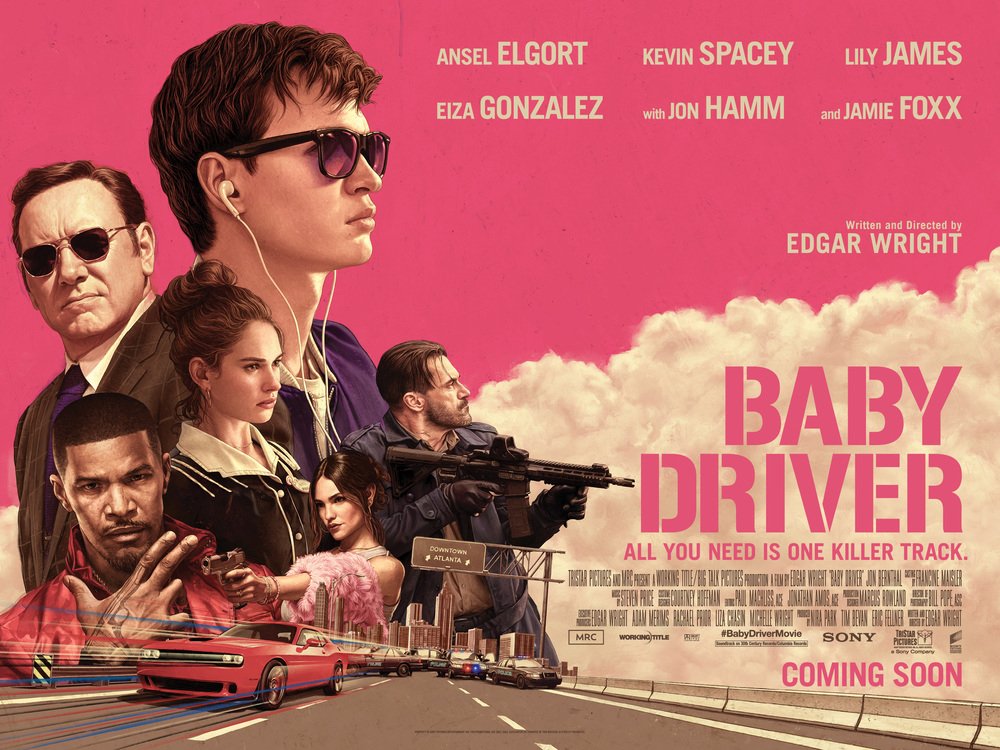
"Baby Driver" is what Fast, Furious fun REALLY looks like!

Who doesn’t love a good car-chase movie?  Those Vin Diesel/Dwayne Johnson flicks sure do seem to make a lot of money, but we could debate about whether those are actually car “chase” movies or car “wrecked” movies.  Anyway, there are a number of cinemaphiles who preach the gospel of such flicks as Bullitt, To Live and Die in L.A. and (in a way) the Mad Max movies.  I start this piece with mention of the style of those films, but I am already wondering if I’m going down the wrong path, as Edgar Wright’s latest, Baby Driver, is something altogether similar, yet wonderously unique among them.

Our driver is Baby (Ansel Elgort), an orphaned, insular kid who walks to his own beat, orchestrated by the buds in his ears, belting out one of hundreds of playlists that help to subdue the tinnitus he has suffered since a childhood tragedy, but more appealingly to Kevin Spacey’s Doc, the head of a bank-busting crime syndicate, it makes him the best getaway driver in the business.  He’s so good that he’s the only constant member of crew that rotates it’s criminals between characters such as Griff (Jon Bernthal), Buddy (Jon Hamm), Darling (Eiza Gonzalez), and Bats (Jamie Foxx), among others.  Baby owes Doc a large debt, and now that it’s almost paid off, he wants nothing more than to be done with a life of crime, and to just drive off into the sunset with Deborah (Lily James), the good-hearted waitress who sings her way into his life ("Baby - your name’s “Baby?” You get all of the good songs," she says to him during one of their breezy encounters).

So what makes this movie any different from the 70s influences (The Driver and Vanishing Point) that it wears on its sleeves as Go-Faster stripes?  Well, aside from swapping the usual concrete jungles of Los Angeles or New York for the refreshing setting of Atlanta, Georgia, this movie is also kinda-sorta a musical.  The opening sequence, a rip-roaring, white-knuckle chase set to "Bellbottoms" by Jon Spencer Blues Explosion, shows masterful editing and spatial choreography. It also shows that Wright has his own ideas about what makes a good car chase - speed, sound, fury and locale, but not necessarily the smash-'em-up approach where a dozen cop cars have flipped over before the first left turn.

Then the opening title sequence immediately follows, and we begin to get the feel for the rhythm changes Wright will use throughout - a one-take tracking shot which follows Elgort as he picks up coffee, swings on lampposts, shadow-mimics graffiti, and awkwardly mimes to lyrics in the same way that we all do once submerged in our own in-ear soundtrack to our lives. All of the musical cues and ticks are so perfectly aligned to the on-screen action that the whole thing feels organic, part of one fluid machine.

The soundtrack is immense, sure to influence your life in the same way that it does Baby’s, with The Commodores “Easy (Like Sunday Morning)” a recurring motif that accompanies joy, revelation, and sadness. There’s also the lesser-known Queen track “Brighton Rock,” and the brilliance of Young MC’s “Know How.”  These are just three from a litany of carefully-selected choices, from a director who wants his film to be informed by the same music that pieces together the fabric of Baby’s emotional arc. It’s an audio/visual jigsaw puzzle that pieces together almost perfectly.

It’s only when the brilliance of scenes such as a laundromat headphone waltz between James and Elgort, or the wonderfully-played exchanges with his deaf foster-father, give way to more straightforward action mechanics that the movie slows, but it never stalls.  These speed-up/slow-downs in the movie’s pace also feel musical, a cadence of storytelling to match the feel of the soundtrack.  Lines of dialogue are layered upon the rhythm of the action,and gunfire matches drumbeats in such a way that by then, you’re so attuned to the DNA of Wright’s film that you almost don’t notice them. Like all of the best albums, re-watches/listens will be a must.

The cast are uniformly great.  Elgort was in line to play the young Han Solo, but here he has the chance to shoot first with a role that sets the bar for cool, as well as ensuring Baby has a vulnerable awkwardness, making his fate worth rooting for. Lily James compliments him perfectly in the hip-to-be-cool stakes, with whip sharp quips and Tarantino-style wordplay. Any worries that she’s simply on-board to be rescued by Baby go out the window by the time the satisfying coda plays out. Jamie Foxx plays the intimidation card to perfection, Kevin Spacey brings his Swimming-with-Sharks persona to the heist table, revelling in the chance to chew on Wright’s dialogue, and Jon Hamm gets an unpredictable arc, which doesn’t entirely work, but as always, he’s very watchable.

I thought a couple of characters began to behave out-of-character in the film’s climax, but by that time, the movie had generated so much goodwill with me that I was willing to forgive these imperfections.  If Edgar Wright leaving the Ant-Man movie three years ago is the reason this movie got made, then I am definitely glad he and Marvel parted ways.  Baby Driver is a pulse-pounding thriller, a film-noir, a heist movie, and also, of course, a musical, a love story, and a tale of tragedy buried underneath.  It belongs in a discussion alongside those great heist/chase movies mentioned above, but it is so original that it will never be mistaken for any of them.

Saturday, March 4, 2017

No Country for Old Man "Logan"


Hmmm… so what would happen if The Coen Brothers, John Ford, Werner Herzog and … oh, let’s say... Clint Eastwood all got together in a room and decided to create a “superhero” movie?  I’ll grant you a moment to recover from the cluster-mash of images that have certainly just exploded into your movie-loving imagination… Better now?  I had never actually contemplated such a question myself, but after seeing Logan, I wonder if the result of that dream collaboration would not have looked something like this.

Hugh Jackman has spent almost eighteen years playing this character across nine movies, and doing it so effectively that the original comic-book version of the character as a five-foot, five-inch tall Canadian has been almost entirely forgotten. Some of the movies he’s been in have been less than stellar, but no one has ever accused Jackman of giving less than one hundred percent of himself every time he’s strapped on those CGI-created claws.  You may not believe him when he says this is the last time he’ll play the character (speaking for myself, I am not completely convinced), but if this is to be his last outing as Wolverine, then we should all be glad that he saved the best for last.

The time is 2029, and director James Mangold (who also directed The Wolverine) shows us a time in which mutants have all but vanished from the face of the earth and no new ones are being born.  Logan has outlasted all his friends save for a now-Alzheimer’s ridden Charles Xavier (once again played by Sir Patrick Stewart), and is now a limousine driver in El Paso.  When Logan is not caring for the former Professor in their sorta-hideout across the border in Mexico, he often finds himself at the bottom of a bottle, a sad broken shell of a former hero.

That all must quickly fall by the wayside when Logan comes across Laura (played superbly by young newcomer Dafne Keen), a seemingly mute child on the run with her nurse and caretaker, Gabriella (Elizabeth Rodriguez).  Gabriella explains that corporate mercenaries known as the "Reavers" are hunting Laura, and gives Logan a sizeable sum of money to ferry them to "Eden," a safe haven near the Canadian border.  Logan reluctantly agrees, but it doesn’t go according to plan, and he ends up with a surprise stowaway when he returns home.

Charles reveals he’s been communicating with Laura telepathically for some time, and that she is, in fact, a mutant.  The Reavers, led by the cyborg Donald Pierce (Boyd Holbrook), descend upon Logan and Charles' hideout to take Laura, and here the reason for her being hunted is revealed. What ensues is a film that is equal parts road trip and western, as our three heroes set out for “Eden,” and along the way, the truth of what has happened to mutants, the X-Men, and why Laura is on the run is revealed.  

While the plot has some incredible revelations about the X-Men Movie “universe,” what drives this movie is character.  Carrying the physical and emotional weight of a 200-something year-old man, Logan limps his way across the country, coughing and exhausted, slowly grinding into nothing.  If not for the charges in his care, one would think Logan would like nothing else but to lie down in front of an oncoming train, but what Laura is (a human molded into weapon, not unlike Logan himself), and maybe more importantly WHO she is, gives the Wolverine one last purpose.

Of course, Jackman is once again iconic in this role, but let it be known that Dafne Keen is a showstealer here. Even in silence, she carries her character’s tragic history with her, eyes conveying years of horror and torture. When she finally does speak, it is powerful, yet incredibly charming.  If you thought Arya Stark was a little Toughie, you ain’t seen nothin’ yet (even to the point Laura has her own list of names to recite, though in an entirely different context).

The rest of the cast is exceptional, too.  Stewart is heartbreakingly good in the film, as dementia makes him both vulnerable and dangerous (his brain, which has the power to release psionic blasts paralyzing those anywhere near him, has been labeled a Weapon of Mass Destruction).  Stephen Merchant is endearing as Caliban, an albino mutant who helps Logan care for the professor, and while none of the villains are given a robust characterization, they are all given enough moments to shine in their roles that they are not mere mustache-twirling caricatures.

Logan is a visceral tale of what happens when a man given too much time finally starts running out of it.  It is an inspired, ambitious, and violent Neo-Western/ Superhero Chase film, leading me to think of David Mackenzie’s recent film Hell or High Water afterwards, with a couple of mutants thrown in there for good measure.  Mangold’s story takes time to allow a few key sequences to really stretch out and breathe, which may lead some viewers to feel the movie to seem "long" at times, but I did not see it that way. On the contrary, the film’s two-hour, twenty-minute length gives us an opportunity to see so much more of these characters, their surroundings, and how they respond to them, and makes the violence that ends some of those moments all the more shocking.

The best mutant stories, both in the comics and on film, give insight into the nature of humanity, and Logan does this in spades.  Time, mortality and legacy are all at the heart of this film, making it what I believe to be the strongest X-Men film to date.  Surely Messrs. Coen, Ford, Herzog and/or Eastwood could not have done any better.

Friday, January 27, 2017

The latest Tom Ford design - "Nocturnal Animals"

Lost love is “lost” because not only is the love gone, but you are misplaced as well, changed into something you weren't before, and it may be years before you realize it. When the crying is done, you move on - you adjust, you grow, you heal.  Maybe you’ll end up meeting someone better than that awful person who ripped up your heart - someone who makes you feel alive and free, someone who makes you forget and forgive the pain your last love caused.  Or instead, maybe you’ll slowly slip into despair, longing and regret.  Maybe you’ll sit and wait for that text, or that e-mail, or that phone call… all but certain that none of them will ever come.  Maybe you’ll sit and wait and watch the door, hoping he/she will come through it.  Maybe he/she will even be smiling when you next see him/her… or maybe they won’t.

Nocturnal Animals, the second film from Tom Ford, the fashion designer who so impressively made his foray into filmmaking with A Single Man seven years ago, is based on a novel that bears little resemblance to this movie.  Ford discovered the novel "Tony and Susan" by Austin Wright and contemplated how to actually adapt the book into two different films. The more he churned the story in his mind, however, his imagination began to formulate something that resulted in this offbeat, non-linear tale of a woman who believed she was growing into a better person by casting her first husband aside, then comes to realize over the next decade how guilty she was of hurting him and destroying her own happiness.

Beginning with images so incredibly silly, yet so awfully uncomfortable to view, Ford instantly sets a tone that will make discovering all the traits of these characters, both the “real” ones and the characters in the novel-within-the-movie, all the more impactful.  The images are part of a conceptual art exhibit hosted by Amy Adams' Susan, a gallery-owning high roller in the Los Angeles art world.  Susan is beautiful and haughty, living an extravagant lifestyle funded largely, we assume, by her husband Hutton, played with born-into-privilege knowingness by Armie Hammer, and thoroughly, thoroughly miserable.  After her opening, Susan gives herself a nasty paper cut opening a package: the manuscript of a first novel by Edward Sheffield, Susan’s first husband.  She’s disturbed by the package and the accompanying note, telling her that he has dedicated the novel to her.

Susan soon settles in with Edward’s novel.  Without warning, we cut to Susan’s visual interpretation of the book.  This story-within-a-story begins with Tony (Jake Gyllenhaal) driving his wife, Laura (Isla Fisher), and their daughter, India (Ellie Bamber), to a weekend home.  They’re driving through the night on barren Texas roads, and in an instant, things go very, very wrong.  It isn’t fair to describe what Tony and his family endures, as to do so would diminish its horror.  I will say that this scene of roadside terror is one of the most frightening things I’ve seen on film since, maybe, Blue Velvet. This has nothing to do with physical violence, as none is shown, but the scene takes its time tormenting us.  It is so realistic, and it could happen to any of us - you’re in the wrong place at the wrong time and your world is forever altered.

Susan is so disturbed by the novel that the almost subliminal questions she’s been having about her life begin to make their way to the surface.  Is this text some fictionalized version of some horrific event that happened in her and Edward’s own shared past? Her memories of life with Edward then present a third line of narrative, with Edward (also played by Gyllenhaal) and Susan as young and idealistic lovers.  He encourages her to pursue art - not as a business, but as a calling.  She wants him to be more responsible, or realistic.  She dreads turning into her materialistic upper-crust mother, but he’s not so sure she really dreads it.  Emotional damage ensues, but nothing like the stuff that happens in Edward’s novel. This is a movie that, among other things, trusts the viewer to make sense of it, or maybe demands the viewer make sense of it.  All the threads pull together, we presume, when Edward and Susan (whose current life continues to turn to rot as she makes her way through Edward’s novel) agree to meet again in “real life.”

The triumph of the film is how the individual stories are kept in the air so beautifully by Ford, and how the individual actors can convey so much about their jaded, miserable characters with a minimum of exposition (Armie Hammer’s Hutton, away on business, is cheating on her so blatantly he’s almost too bored to hide it anymore).  Aaron Taylor-Johnson as the scumbag who terrorizes the novel’s “hero” shows a side of his ability audiences have never seen before, and of course, Amy Adams is her usual spectacular self.  Michael Shannon also achieves a career high (and an Academy Award nomination) with his dry but enigmatic portrayal of a Texas lawman with nothing left to lose.

The final scene is one that, I presume, intends to have viewers debating as they leave the theater, and I admit that I would have welcomed such a discussion had I not been alone when I saw the movie.  I suppose that without the benefit of a human sounding board for my reaction, I found Nocturnal Animals to be a reminder of how much the loves we leave behind form us in such ways that continue to shape our outlook on life.  Whether those past loves were good or bad, happy or sad, we will have suffered damage of some sort along the way, and even inflicted some of our own.  Seeing such a simple lesson in dealing with adult emotions told in such a powerful fashion may have been a tad uncomfortable, but it made for a movie that is definitely worth seeing.

Saturday, October 15, 2016

"The Accountant" sure adds up for me

While The Accountant may be a movie of the sort of formula we’ve seen done before (I first think of George Clooney’s The American or Clive Owen’s The International, but there are others), it’s sure nice when one of these “international web of intrigue” flicks that we think will be so predictable turns out to be so enjoyable.  Sure, The Accountant’s plot is all but paper-thin and the major points of the third act are visible coming down the road from a mile away, but darn it, it’s just done so well that I enjoyed the crap out of this one.

This time around, Ben Affleck plays Christian Wolff (one of many aliases the character utilizes), a seemingly anti-social bean counter with a knack for bluntness.  In truth, he has a high-functioning form of autism with a “Beautiful-Mind”-like talent for numbers, apparently living a quiet life as an accountant, operating out of a non-descript strip mall office and helping struggling locals with their taxes.  On the side, however, he also investigates the money problems of dangerous clients and powerful corporations and “settling accounts” by any means necessary.  Having this sort of clientele is not without its risks, however, and thankfully Wolff was raised by his Army SpecOps father to hone and channel his disability, and is now an expert marksman and ass-kicker, should any such complications arise.  In an attempt to find some more legitimate business, his unseen secretary/handler/confidante (I know, it’s getting goofy-sounding, but just roll with it for now) steers him towards a freelance job investigating the books of a robotics company headed by Lamar Black (John Lithgow), where a low-level employee (Anna Kendrick) has discovered some accounting discrepancies.  

While there are three sets of characters to follow through the movie, and all of the supporting actors are terrific (maybe with the exception of Lithgow and Kendrick, but admittedly, neither had much screen time to work with), it’s obvious that this is Affleck’s movie, and he carried it with ease upon his now Rock-like shoulders.  Embracing the tics and maddening intensity of a true autistic, Affleck demonstrates once again how he has honed his acting skills into a much more restrained, nuanced performance than I believe he could have delivered a decade ago.  This is an actor who no longer accepts being a weak link in any of his films, and has worked his way to deserving leading-man status.

Director Gavin O’Connor (Miracle, Pride and Glory) brings to life a script that has been floating around Hollywood for several years (and even landed on the 2011 “Black List” of best unproduced screenplays), using flashbacks and changes in character perspective to deftly juggle the film’s numerous narrative threads. Admittedly, the movie occasionally drifts into territory that borders on farcical, but it always manages to rein itself in at just the right moment before straining the limits of credulity to the breaking point.  He succeeds at striking a balance between action and solemnity that will feel instantly familiar to fans of his well-received MMA drama Warrior.

The tone O’Connor sets is probably what I enjoyed about most about the movie.  With so many Bourne-esque thrillers of the last twenty years remaining so dour and serious throughout their runtime, The Accountant has just a handful of winks or dry-humor moments to break the tension for just a second without coming across as silly.  The result is a thriller that’s been tossed into a blender with a gleefully silly action flick and has come out far more compelling than either of those ideas would have been on their own, and also comes as a welcome reminder that even though the box office these days tends to be overrun with sequels, remakes, reboots and “re-imaginings,” it might be possible that Hollywood hasn’t quite run out of great ideas just yet.

Saturday, October 8, 2016

"The Girl on the Train" derails shortly after departure...

The famed film critic Gene Siskel once said that “a good movie is never too long,” meaning if a film tells an enjoyable story, it will never FEEL long and will take as much time as is needed to tell that story in an entertaining manner.  I don’t recall ever hearing of him saying the opposite, that a bad movie can be too short, but if there was ever a case for a movie needing to be longer, The Girl on the Train is it.

At 112 minutes, The Girl on the Train could have easily stood to be stretched out for another fifteen minutes or so in order to give us some sense of perspective on these characters.  We’re presented a story of three women, all of whom must have reasons for the way they are and the things they do, and we’re given very capable and interesting actresses to inhabit those roles, yet an hour and fifty minutes later, I’m still wanting to know WHY these characters are the ways they are.

Rachel (Emily Blunt) is a woman whose husband Tom (Justin Theroux) has left her for placid, icy Anna (Rebecca Ferguson).  We quickly see that Rachel has a drinking problem, the reason for which is glossed over as being due to fertility problems, I guess.  Apparently unemployed, she drinks vodka out of a water bottle all day and rides the Metro-North train to New York City and back, past her old house, and spots Megan, the woman who lives next door (Haley Bennett), and becomes obsessed with her supposedly perfect life.  One night, Rachel drunkenly stumbles off the train and blacks out.  When she wakes up, she’s covered in blood, has no idea what happened, and finds out Megan has disappeared.  The rest of the movie is a piecing together of what happened that night.

As Rachel, Blunt is the one assigned the task of carrying the movie, and if she’s really too beautiful to ever be taken seriously as a hopeless drunk, she at least commits to portraying an ugly type of alcoholism, stumbling around with a flushed face, chapped lips and smudged makeup, and waking up at one point in a sticky, ambiguous mess of blood and embarrassment.  By contrast, Bennett’s Megan is a pitiful stereotype of a Femme-Fatale-With-Secret-Pain. “I tend to smile when I’m nervous… sometimes I laugh,” she tells her male therapist, who of course is captivated by all the lip-biting and skirt-hiking going on.  The third focal character is Anna (Rebecca Ferguson), after having “stolen” Tom from Rachel, is now fully invested in being a two-dimensional platitude of a stay-at-home mother, fatigued by hours of farmer’s market shopping and sweet potato pureeing for her oh-so-adorable baby.

The movie’s time-jumping structure is interesting, and gave me a sense that there could’ve been a way to reveal things about these people’s motivations to make us more invested in them, but director Tate Taylor (having previously made The Help and Get on Up) is too busy awkwardly lumbering from plot point to plot point to give them any time to breathe. The result is the worst of both worlds: characters kept at a distance, hurtling through a story we don’t buy, with an ending you can see coming by the end of the second act.  We never learn enough about any of them to understand why they are the way they are, and as such, we’re forced to accept them as almost-caricatures - the Misunderstood Drunk, the Lost Millennial, the Self-Absorbed First-Time Mother, etc., etc.

Without any deeper understanding of why these people are the ways they are, then exploring what they do comes across as just soap opera, or a made-for-Lifetime Thursday night movie.  That was disappointing, as the potential for a very absorbing look into the three central characters is apparent on screen.  Alas, all Tate Taylor gives us is something that may have aspired to be more like Gone Girl or The Girl With the Dragon Tattoo, but ended up being something akin to a slightly-more serious episode of "Absolutely Fabulous."