Showing posts with label Scott. Show all posts

Saturday, January 27, 2018

"All the Money in the World" is a buck or two short

A Ridley Scott movie always presents us with a stylized make-believe world or period of actual history, almost always perfect in detail and beautifully filmed, and his latest is no exception.  In All the Money in the World, he gives us the true story (well, a very movie-ized version of the story) of the kidnapping of John Paul Getty, III, the grandson of billionaire oil magnate Jean Paul Getty, who was not only the richest man in the world, but at the time was the wealthiest individual in all of recorded history.  Accounts of Getty’s uber-miserly ways are so extraordinary that it doesn’t require much imagination to believe that the $17 million demanded for his “favorite” grandson’s safe return was simply out of the question.  

The movie’s plot centers on Gail Harris-Getty (Michelle Williams), Paul's devoted, strong-willed mother, who unlike the elder Getty (Christopher Plummer), has consistently chosen her children over his fortune.  Getty does assign his “fixer,” former CIA man Fletcher Chace (Mark Wahlberg) to do what he can to negotiate better terms for Paul’s release, and Fletcher and Gail find themselves in a tense, sometimes even hostile, partnership.  These three personalities have as much conflict between them as they as a trio have with the kidnappers, and the situation drags on so long that the original kidnappers actually “sell” their hostage to the local Mafia when they tire of the process. It makes me wonder if Rome in 1973 must’ve been something like the old Wild West, but with a lot more Vespas, fine wine and Communists around.

I am constantly amazed by Ridley Scott as a filmmaker.  Of course, he doesn’t hit home runs every time he makes a film, but it’s his skill as actually MAKING the things, even more so now that he’s breached the 80-years-of-age milestone, is almost beyond my ability to describe.  I defy anyone to point to any of his films and say it wasn’t at least a visual pleasure.  He is an underrated master of world-building, something essential when creating such historical epics as Gladiator and Kingdom of Heaven, or the sci-fi environs of Blade Runner and his Alien films.

It seems the only thing the general public knows about this movie is how Scott decided, on his own accord, to completely remove Kevin Spacey’s performance as the elder Getty from the film after it was already finished and ready for its world premiere last November.  In less than four weeks, he rebuilt sets, reassembled the entire cast and crew, wooed Christopher Plummer to take on the role of Getty, reshot twenty-two scenes (IN JUST NINE DAYS!!!) and ran all that footage through post-production and editing, in time for a Christmas Day release.

While the feat of movie-making skill Sir Ridley managed in re-tooling this film just blows my mind and increases my admiration for him, the resulting film as a whole is far from his best, and not even as good as some other, more pedestrian thrillers.  As I did after such films of his as The Counselor and Body of Lies, I wonder about Scott’s ability to truly judge a screenplay, as despite never being bored by the plot, I didn’t think David Scarpa’s screenplay provided enough highs and lows in the tension level to generate any great emotional payoff.  

Michelle Williams as Gail Harris carries the film, and is very good in becoming a strange mixture of “nouveau riche” and “poor-but-proud,” all with a Long Island/Kennedy-esque accent and composure that keeps her character from coming across as a stereotypical panicked mother.  She is perfectly aware of how she is perceived to be so intrinsically linked to the Getty empire, but in a world in which money talks, the only hope she has of getting her son back alive is to enter into the Faustian schemes and plans Getty’s army of lawyers practice.

Christopher Plummer assuming the role of the elder Getty also probably made the movie even better than it would’ve been without him, as despite his callous, dead-on-the-inside actions, he relates a few things to us that show he was once actually a human being.   A performance that is all the more amazing knowing how little time he had to prepare for it, Plummer depicts Getty throughout the years, and there are some glimpses of a doting grandfather, but they’re all consumed by a lust for wealth that all too often comes at the expense of family.  Plummer elicits both disgust and pity from the audience in near-equal measure.

Mark Wahlberg, however, is woefully mis-cast in a part that demands an older, more grizzled man to properly convey the world-wise savvy and street-smarts his character supposedly possesses.  I’m sure the film’s financiers demanded a more bankable star like Wahlberg in the role to help ensure ticket sales, but I wonder if someone more everyday-Joe-ish like Paul Giamatti or Alfred Molina would’ve been more effective.

All the Money in the World won’t ever be mentioned in the ranks of great thrillers, but it does have a slow-burn type of dramatic intensity, all held together by at least two excellent pieces of film acting. It’s most impressive achievement to my mind, though, is to make me wonder if, given how Ridley Scott so quickly and effectively retooled his own movie at the last minute, wouldn’t it have been great if somebody had asked him to try and save Justice League…?

Tuesday, October 10, 2017

"Blade Runner 2049" proves sequels can do it even better

It’s been thirty-five years since the original Blade Runner film was in theaters, and nobody saw it then.  Well, ALMOST nobody saw it, but thank God for VHS tapes and cable TV, for through these media, some folks realized what they’d missed.  Sure, that tacked-on “happy ending” felt out of place, and the sporadic voice-over narration that kept popping up in places was really unnecessary… but oh, THAT WORLD!  The visual style and atmosphere director Ridley Scott created, the Philip Marlowe-type character so cooly portrayed by Harrison Ford, the haunting score by famed composer Vangelis, and the ideas put forth about life and what it means! There’s a reason the market allowed (demanded?) Warner Bros. to keep funding the restoration and re-editing efforts that eventually led to Ridley Scott being granted the chance to craft a definitive edit of the film - the reason being that the seeds of a true science fiction masterpiece were always there, and 2007’s “Final Cut” of the film is exactly that.  

So here we are with Blade Runner 2049, set thirty years after the events of the first film, following a new “Blade Runner” (policemen charged with the task of retiring/executing rogue artificial humans, called “Replicants”), known only as “K,” and portrayed by Ryan Gosling.  He is assigned the task of tracking down one certain Replicant whose existence can, as his superior officer (played by Robin Wright) explains it, can “break the world.”  She doesn’t mean that literally, of course (that would be just plain silly), but apparently society would totally fall apart if this particular Replicant becomes known to the world at large.  In an attempt at “breaking” the world, the blind trillionaire industrialist (Jared Leto) whose company manufactures Replicants is also trying to find this particular rogue Replicant, and sends his Replicant assistant/hit-woman Luv (Sylvia Hoeks) to find it and, more importantly, stop K from finding it.

I won’t divulge much more plot than that, as doing so would (A) take too long, and (B) distract you from what this movie does best, which is the same thing the original film did best - create a world in a stunning, visually-breathtaking fashion.  Director Denis Villeneuve (director of both Sicario and Arrival) helms this film, with Ridley Scott producing, and a more appropriate choice to follow Sir Ridley could not have been made, as he so wonderfully keeps the SciFi-noir feel and vibe of the original film.  

Villeneuve also reteams with his cinematographer from both Sicario and Arrival, Roger Deakins, and this master photographer has topped himself once again. His work here is just as impressive (perhaps even more so) than anything he's done before. The constant gloom and rain, with neon and vehicle lights slashing through; the harsh whites in K's police station; the almost-red glow that permeates The Wallce Corporation's interiors. Combined with incredible set design and visual effects, this movie is a veritable package of Oscar nominations to come.


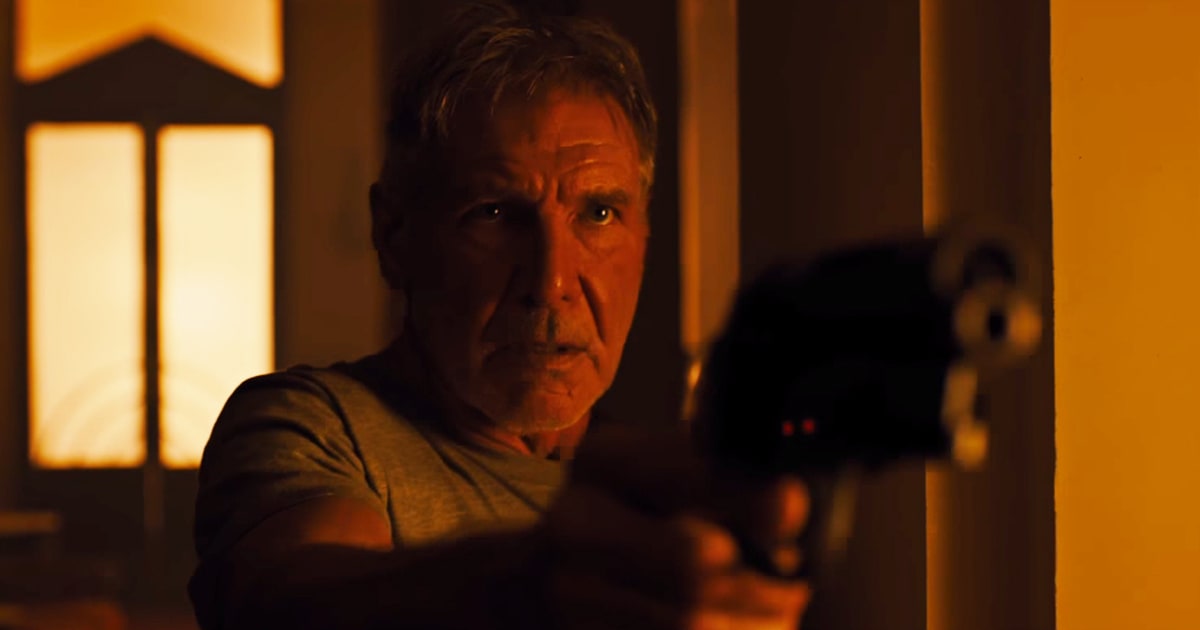
Ryan Gosling plays K with a weary, put-upon vibe, conveying a run-down-by-the-world personality that calls for our sympathy. The less he externalizes the character's feelings, the more it seems we get a gauge of them. Harrison Ford also returns as the original “Blade Runner,” Rick Deckard, and it is almost painful to see what has become of the character. Ford's naturally quiet acting style is used to great advantage here, as his low-tone voice and intense gaze tell us just how hard his life has been since we last saw him. Jared Leto's character, on the other hand, may not come across as frightening to the degree the original film's Roy Batty did, but Leto uses his own acting style to communicate an insane sense of the world and a warped view of how to use his power and influence to shape it. This change in the type of threat, from physical to philosophical, also distinguishes this movie from lots of sequels.

Some critics point to the film’s two hour and forty-four minute runtime as a fault, but I strongly disagree.  I never found Blade Runner 2049 to be slow.  Many have used the term "slow burn" to describe the pace of this film, and while I agree with that description, I'm reluctant to use it myself because I understand how that term can be interpreted by some to mean "it's long, and while some people like it that way, I probably won't." Having the process of K come across each plot-point, then have him silently react to it and process its meaning, is what kept me mentally leaning forward in my seat. The original film wasn't in a hurry, although to be fair, it didn't have as much ground to cover as this follow-up does. This movie moves along at a pace that enhances our anticipation of the next move in K's journey, and a more rapid delivery of plot-points would lessen their effect.

Blade Runner 2049 is the kind of movie that film students will be writing papers on for decades.  This isn’t your average “it’s so deep, man”-type of film. This is not Fight Club, American Psycho, or Inception, where the depth and complexity fade after a first viewing into simple entertainment. This is more like 2001: A Space Odyssey, Solaris or, yes, Blade Runner.  A film that resists easy understandings.  A film that is open to endless intertextual reading when examined in light of its source material, director, cinematographer, and stars.  A film whose flaws reflect deep flaws in society.  A film that tries to tell us something novel about ourselves. A film that re-invents film form and language to shake you to your very core, if you’ll only let it.

Early box office returns show that this film may suffer the same fate as the original, in the sense that mass audiences are not flocking to see it on its first theatrical run.  Make no mistake, however - Blade Runner 2049 is at least as good as Blade Runner, and only time will tell if it reaches the legendary status of its predecessor.  The most impactful moments in this film are in a different class than anything in Ridley Scott’s original. They distinguish it as its own film, and justify its existence as a sequel in the age of the remake, reboot, and franchise.

Saturday, October 3, 2015

Why "The Martian"? Because... Science!!!

Every time I sit down to do one of these essays about a film from Sir Ridley Scott, I feel like I’m obligated to inform the reader that he or she may need to take my opinions with a grain of salt.  My fandom of Sir Ridley’s work is well-documented, and I wouldn’t blame anybody if they said my objectivity in reviewing his movies may be questionable. I like to believe that I can be reasonable enough, however, to acknowledge that he’s had some “misses” over the last decade (cough… The Counselor… cough… Prometheus… cough... ), but even those misses have had things about them to love and/or admire, though, and those qualities keep me eagerly anticipating whatever he may do next.  

Thankfully, with The Martian, Sir Ridley has hit one out of the proverbial park, and has produced a film that certainly ranks right up alongside his best work.  It is a great combination of survival story (see a guy figure out how to grow potatoes in his own poop!), detective story (wait, that photo and this photo must mean somebody’s still moving down there!) and heart-tugging rescue story (can they catch the guy in a space suit moving faster than speeding train?).

The Martian is based on the debut novel from former software engineer Andy Weir, written out of his love for all things science, and his admiration of the men and women who practice it and utilize it to explore the universe. The story is of astronaut/botanist Mark Watney (played with great charm by Matt Damon), who is left for dead on the surface of Mars when his mission is scrubbed because of a violent storm.  Left with supplies that will only last six weeks, he must find a way to not only communicate with Earth and hope a rescue mission can be sent, but also to find a way to produce enough food, water and breathable air to last the three or more years it would take for that mission to save him.  

While there is certainly enough of the Robinson Crusoe-type stuff one would expect to find in such a story, there is enough of the subsequent activities on Earth depicted that the movie is not just a retread of Cast Away set in space.  NASA comes to realize Watney has survived and struggle to find a way to deal with that knowledge and plan a course of action.  Astronauts make plans, engineers at Jet Propulsion Labs struggle to implement them, NASA administrators work to make them happen, all under the pressure of knowing Watney may very well starve to death before they can get to him. These portions of the film are filled with characters just as interesting (in their own ways) as Watney, and the movie is fortunate to be filled with such wonderful actors as Jeff Daniels, Chiwetel Ejiofor, Jessica Chastain and Michael Pena in these roles, all of whom do fantastic jobs of creating believable characters with clear motivations, all with the seemingly-limited screen time they have.

Okay, sure, we all know Mars’ atmosphere is way too thin to actually produce a storm strong enough to endanger any manned mission there (or at least those of us who didn’t sleep through eleventh-grade science class know - you all know you you are…), but any enjoyment of a movie must require some suspension of disbelief, and this great story makes it easy for us to do so.   The genius of The Martian is its handling of what is, by its nature, the most technical of human endeavors and keeping it on a level the layman can not only understand, but enjoy.  What made the novel so incredibly interesting - it’s descriptions of the methods Watney used to engineer the solutions to his problems - could have been the very thing to doom the movie adaptation for general audiences, but Drew Goddard’s script does a fantastic job of feeding us just enough science-lingo to explain what Watney is doing without bogging us down in minutia (“I’ve done the math,” an engineer explains to an administrator at one point, “it checks out”).  The entire narrative thread of the movie is propelled by this problem-solving, which is a pretty novel thing for a movie in today’s age of the big-screen shoot-’em-up spectacle that relies on action set pieces to move from one plot point to another.  

The focus of the story, though, is Watney, and Matt Damon gives a us stellar performance.  He tends to be a “quiet” actor, steering clear of roles that would require him to be bombastic or over-the-top (I’m looking at you, Sean Penn…), and this role suits him well.  Characters he portrays tend to be more reserved and rely more on emotion and body language to convey ideas, and his spin on Mark Watney is dead-on perfect for that philosophy. Watney is what we all hope we could be in such a situation, and his performance of the character is pitch-perfect.  He combats the despair of his situation not only with rational thinking, but also with wit and humor, both cleverly shown to us by means of the video logs he keeps.  Despite being more physically alone than any human being ever has, he never totally loses hope, although he does come close a time or two, as I’m sure we all would.

As I mentioned earlier, Sir Ridley has had some less-than-stellar work in theaters over the last ten years (although even those films tend to improve when he re-cuts them for home video, which could easily be the subject of another lengthy essay), but no matter what one’s opinion may be about the narrative quality of any of those movies, I defy anyone to say that his movies aren’t always beautiful to watch.  The Martian is no exception. Utilizing the region of Jordan where parts of Lawrence of Arabia were shot more than fifty years ago, along with some help from post-production color-correction, he has created an incredibly believable Mars.  His directing skills are firing on all cylinders here, and his visual choices tell us as much as the script’s words do.  Time after time, he is moving us from lush, panoramic shot of beautiful Martian landscape, to an object presenting a challenge, to a facial expression telling us all we need to know about that challenge.

You may think the plot sounds as though is not terribly different from Cast Away or Robinson Crusoe or Gravity, but the character of Mark Watney IS original.  It’s easy to say that this is a Marooned-in-Space movie, and in a way it is, but it is so much more than that.  It is a story of personality.  It is a story of perseverance.  It is a story of how calm, rational thinking can eventually overcome most any problem.  It is a story of how even those calm, rational thinkers still have emotion and must factor that into their decisions.

...and it’s Ridley Scott’s best movie in a decade, so it’s got that going for it, too.

Monday, June 30, 2014

Ridley Scott's "The Counselor" leaves me in great need of counseling...

Here's a recipe for a Can't-Miss "Great Hollywood Film" - 1.) take an original screenplay from Cormac McCarthy, the author of such hallmarks of recent American literature as "The Road," "Blood Meridian" and "The Sunset Limited."  2.) Get epic-master Ridley Scott, the director of such crowd-pleasers as Gladiator, Alien and Blade Runner to direct.  3.) Assemble an all-star cast consisting of Oscar winners and nominees like Michael Fassbender, Javier Bardem, Penelope Cruz, Cameron Diaz and Brad Pitt to bring the story to life.  Your result from mixing all these ingredients will without a doubt get you one of the greatest films ever made, no matter what they turn out, right?  Right?  Well...

I watched The Counselor around 8:00 on a Sunday evening, and I am writing this review about eighteen hours later.  I watched the unrated, extended home video edit of the film, not the version that played in theaters last fall and was so savaged by critics and what few moviegoers paid to see it.  I watched it without distraction and without interruption, so as to assure my full attention be devoted to it.  As a result, I have suffered a mostly-sleepless night afterward, having the reprehensible things depicted in this movie invade my dreams and keep me awake for a lot longer than a more enjoyable movie would.  I have struggled to decide just what I think, or more simply, how I even feel, about this film.  I’m still struggling, but perhaps crafting this essay will help me decide just what my final opinion should be. 

The Counselor weaves a tale (or tries to) of the titular El Paso lawyer (Fassbender), who is never referred to by any name other than “Counselor,” planning on making some sort of drug deal with a powerful, shadowy Mexican cartel; a one-time occurrence that will theoretically set up him and his bride-to-be (Penelope Cruz) financially for life.  Since he can only afford to fly to Amsterdam and buy a 3-carat stone for her engagement ring, he apparently needs the money something fierce.  He works with a fairly successful drug-dealer acquaintance (Bardem) and a middleman connection to the cartel (Pitt) to make a sale to dealers in Chicago.  Through a series of double-crosses and mistaken assumptions, the Counselor quickly finds just how incredibly naive he has been, how hopeless his predicament is, and how many people will suffer the consequences of his decisions. 

The plot, as much of one as there is, is fairly simple, and mostly unnecessary, as the bare-bones story structure is mostly a means to provide these characters opportunities to have McCarthy-esque philosophical conversations with one another, so I’ll spare you any deeper summarization than that.  Save for a few minor action/violence scenes to bridge scenes of dialogue, the film flows more like one of McCarthy’s stage plays, with a great number of scenes consisting primarily of two characters talking at great length. Of course, there is that much-talked-about scene with Cameron Diaz doing… oh, how shall I say it?... gynecologically immoral things to the windscreen of a Ferrari, but even that scene is a talking scene, a flashback playing over Javier Bardem’s character talking about the event to the Counselor. 

Cormac McCarthy always populates his stories with morally bankrupt figures, and he may have surpassed his quota here.  There are no redeemable characters to be found anywhere in this film, save for the Counselor’s poor fiancee’, although one might could claim the level of her innocence/naivete’ is almost so pathetically great that she deserves what she gets, too.  Cameron Diaz’ portrayal of the cheetah-spot tattooed, cheetah-keeping girlfriend/business manager Malkina is so vampy that it’s either a brilliant acting choice or her acknowledging the absurdity of the character, but I’m not sure which.  Even Brad Pitt is not stretching his acting chops much, as he seems to be pretty much playing the same character he portrayed in Thelma & Louise twenty-two years earlier, but perhaps twenty-two years older, and in the only place in life that character could’ve ended up.  Fassbender and Bardem, however, do a credible job, Bardem in particular chewing the scenery enough to convey his character’s feelings of inferiority when next to the sexually and intellectually superior Malkina. 

I can’t imagine that any of Cormac McCarthy’s written work would translate word-for-word to an audible presentation in any conversationally believable manner.  Now, I’ve never heard any of his works in audiobook form, so I suppose I can’t rule out that medium as a possible mean of enjoying his complex dialogue, but there is a reason that (until now) he has never penned the screenplay for any of his other works adapted to film.  Sure, previous movies based on his books are notable for characters waxing philosophic in rather dreary/poetic ways (think Tommy Lee Jones in No Country for Old Men or Matt Damon in All the Pretty Horses), but the screenwriters of those films did a pretty reasonable job of following the Less-is-More rule.  The Counselor, being straight from Cormac McCarthy’s own hand, has no such filter, and for whatever reason, it seems Ridley Scott decided to film every bleepin’ word McCarthy wrote.  For example, Ruben Blades is in only one scene of the movie, speaking to the Counselor over the phone, giving a lengthy Hispanic/New Age-ish existential assessment of the Counselor’s situation, ending by quoting some obscure Mexican poet at length, (literally) driving the Counselor to tears.  Hell, it almost drove ME to tears. 

Avarice seems to be the focal point of whatever moral lesson the film wishes to teach. All of these characters are fabuloulsly wealthy by most any rational person’s definition of the word, yet all of the poor decisions, shady dealings and violent acts the characters exhibit are in pursuit of even greater riches.  The drug trade is the means to that end in this movie, but we never see any drug deals or (with one very brief exception) even any drug use.  There isn’t anything one could construe as a just ending for any of the characters here, so Scott or McCarthy certainly didn’t have any notions of delivering any sort of emotionally satisfying experience to an audience. It seems their only definition of success they possibly could have hoped to achieve was to deliver a blistering morality tale about the inevitable outcome of unchecked greed, and on that level, I suppose I must grant that they did succeed.

In the interest of full disclosure, I remind you that Ridley Scott is one of my all-time favorite filmmakers, so take my views on his work with whatever grains of salt you wish.  His work the last ten years has been spotty, as I acknowledge that his last great work was probably Kingdom of Heaven (and even the theatrical release of that film had structural problems; it was his Director’s Cut that made it to home video that restored lots of excised footage and produced a wonderful film).  Each of his films since, with the possible exception of A Good Year, has had script or story structure problems, probably culminating with how almost-incomprehensible Prometheus turned out to be.  He continues to be the consummate visual artist he has always been, however.  I challenge anyone to deny ALL of his films are visual feasts, and The Counselor is no exception, but I wonder why it seems he cannot identify weak screenplays as he advances in years. There are so many scenes and characters in the Blu-ray version of this movie that serve absolutely no purpose in driving the narrative that I wonder how much Scott’s long-time editor Pietro Scalia was actually in the cutting room during post-production.  Malkina’s visit to a confessional to tease a priest and a scene with John Leguizamo and Dean Norris discussing bodies in barrels are just two such scenes that should have been the first to go.

Did I like The Counselor?  I don’t think this movie is really meant to be “liked.”  It is possible that it is meant to be admired, or even respected.  In the end, it seemed to me that Scott and McCarthy were more intent on illustrating how God laughs at us when we make plans than they were on providing us a tale of redemption from evil or growth from baser desires.  I suppose it is a testament to Scott’s power as a filmmaker that, even in his mid-seventies, he still has the sway to get such a film financed, attract such a cast and get such a story on film despite its obvious shortcomings.   

I can say positive things about the stellar cast and how wonderful a job they all did with what they were given to do.  I can rave about Scott’s gorgeous use of the desert landscapes and corresponding color palettes to make yet another visually luscious film. I can’t see how I could bring myself to say I liked it, however.  As a fan of Ridley Scott, I’m glad I saw it, but I don’t think I’ll be making a point of watching it again.  I’ve lost enough sleep over it already.