Sunday, October 23, 2016

"Stranger Things" is Winona Ryder and lots of other scary stuff!

Praise Netflix!  The streaming video giant has given those of us poor, middle-aged souls who never quite grew up enough to leave the movies (and games… and comics…) of our youth an incredible gift.  The eight-episode series Stranger Things is... well, it’s E.T.!  It’s The Goonies!  It’s Stephen King’s IT!  It’s Stand By Me!  It’s Big Trouble in Little China! You name “it” from geek/nerd culture from 1980 through about 1987, and it’s in here somewhere! Oh, and just so the ‘90s don’t feel left out, there’s that hint of X-Files vibe lurking off in the background to boot! Hell, even the poster released to some outlets as a promotional tool is a direct homage to all of those fantastic Drew Struzan one-sheets we all loved in the ‘80s and ‘90s.

Okay, okay! What’s it about?  The story seems right out of the Steven Spielberg playbook, as 10- or 11-ish year-old Will Byers disappears one night from the fictitious town of Hawkins, Indiana, which sends his single mom Joyce (Winona Ryder, in the show's most obvious nod to the ‘80s), his brother, and his friends and their families into a tailspin as they try to find him.

Eventually they realize something paranormal is going on—especially when the lights in his house seem to start blinking and Mike's sister Nancy's best friend goes missing. There's also a strange girl with a shaved head named Eleven who turns up, for reasons nobody can understand, and Mike and his friends Dustin and Lucas (named, I think quite obviously, for George, the Creator himself) hide her in the basement while they try to figure out how to rescue their friend. There's also the local sheriff (David Harbour), who lives a hermit's life after the loss of his own daughter, and stumbles into the story and knows he has to get involved. 

One of the central tenets of Stranger Things is the existence of a plane of existence the boys call “The Upside Down,” a parallel dimension that exists alongside our own, but swaps out decay and death for every bit of life and flourishing on our own plane.  Those of us who lived pen-and-paper Dungeons & Dragons can quickly tell you (even if you didn’t ask) that this, along with one of the show's major monsters, is drawn directly from that game’s lore.  The show's children—its central characters (who, to the one, are fantastic)—are avid D&D players and, in fact, that's how we meet them: playing a many-hours-long campaign in the basement, and unable to defeat a menacing in-game monster with their powers and rolls of the die.  

Before the eight-hour narrative reaches a conclu-sion, we’ve had mystery, horror, John Hughes-type angst and government Men-in-Black types thrown at us (with Matthew Modine as the main Baddie! - how much more '80s can you get!?!?), and by Jove, it all works! Created by Matt and Russ Duffer, this series perfectly pulls all of its unique stories together into one show. Because this world is so well-constructed, none of these elements stand out as not belonging with the others. That’s a tremendous achievement when you think about how disparate these genres are.  The Duffers and their writing staff incredibly give us numerous moments where one spoken word, or one sound effect, or one reaction shot communicates volumes about a character’s motivation or backstory to us.

Along with the synth underscore composed by experimental band SURVIVE, the series is peppered with hits from the 1980s, making judicious, thematic use of The Clash’s “Should I Stay Or Should I Go,” which has never had a more chilling effect. You’ll also revel in the evocative use of music from the likes of Jefferson Airplane, Toto, The Bangles, Joy Division and Foreigner.
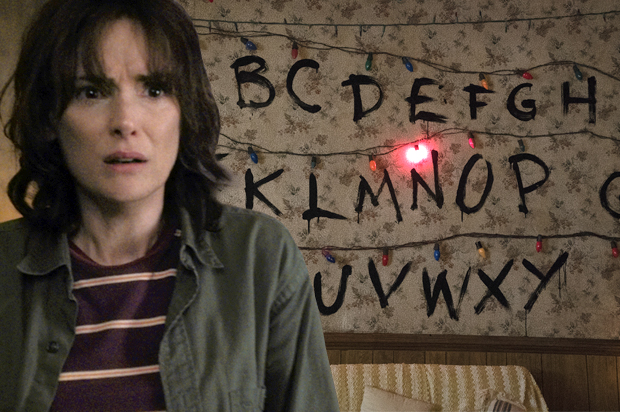
Stranger Things is probably the highest-profile role Ryder has managed to land in many years, and it calls back to a time when she was mainstream cinema’s “It-Girl.” She’s highly effective as Will’s working-class mom, with the script calling on her to play a woman whose world and grasp on conventional reality has broken down — fuelled by grief and a unshaken belief that her son remains alive.

Ryder’s not the only one bringing in a world-class performance on the show — David Harbour is excellent as the town cop trying to unravel the conspiracy.  Even the kids are quite good in a Goonies-esque way as they launch their own investigation, and I can’t begin to describe the beyond-her-years performance of young Millie Bobby Brown as Eleven.


As the series is only eight episodes, Stranger Things is the perfect binge over a weekend.  If you haven’t yet caught it, make it the primary project for your next I-Will-Stay-On-The-Couch-This-Entire-Weekend weekend. Don’t just watch it for the nostalgia or the genuine creeps, watch it because it’s compelling storytelling.

Saturday, October 15, 2016

"The Accountant" sure adds up for me

While The Accountant may be a movie of the sort of formula we’ve seen done before (I first think of George Clooney’s The American or Clive Owen’s The International, but there are others), it’s sure nice when one of these “international web of intrigue” flicks that we think will be so predictable turns out to be so enjoyable.  Sure, The Accountant’s plot is all but paper-thin and the major points of the third act are visible coming down the road from a mile away, but darn it, it’s just done so well that I enjoyed the crap out of this one.

This time around, Ben Affleck plays Christian Wolff (one of many aliases the character utilizes), a seemingly anti-social bean counter with a knack for bluntness.  In truth, he has a high-functioning form of autism with a “Beautiful-Mind”-like talent for numbers, apparently living a quiet life as an accountant, operating out of a non-descript strip mall office and helping struggling locals with their taxes.  On the side, however, he also investigates the money problems of dangerous clients and powerful corporations and “settling accounts” by any means necessary.  Having this sort of clientele is not without its risks, however, and thankfully Wolff was raised by his Army SpecOps father to hone and channel his disability, and is now an expert marksman and ass-kicker, should any such complications arise.  In an attempt to find some more legitimate business, his unseen secretary/handler/confidante (I know, it’s getting goofy-sounding, but just roll with it for now) steers him towards a freelance job investigating the books of a robotics company headed by Lamar Black (John Lithgow), where a low-level employee (Anna Kendrick) has discovered some accounting discrepancies.  

While there are three sets of characters to follow through the movie, and all of the supporting actors are terrific (maybe with the exception of Lithgow and Kendrick, but admittedly, neither had much screen time to work with), it’s obvious that this is Affleck’s movie, and he carried it with ease upon his now Rock-like shoulders.  Embracing the tics and maddening intensity of a true autistic, Affleck demonstrates once again how he has honed his acting skills into a much more restrained, nuanced performance than I believe he could have delivered a decade ago.  This is an actor who no longer accepts being a weak link in any of his films, and has worked his way to deserving leading-man status.

Director Gavin O’Connor (Miracle, Pride and Glory) brings to life a script that has been floating around Hollywood for several years (and even landed on the 2011 “Black List” of best unproduced screenplays), using flashbacks and changes in character perspective to deftly juggle the film’s numerous narrative threads. Admittedly, the movie occasionally drifts into territory that borders on farcical, but it always manages to rein itself in at just the right moment before straining the limits of credulity to the breaking point.  He succeeds at striking a balance between action and solemnity that will feel instantly familiar to fans of his well-received MMA drama Warrior.

The tone O’Connor sets is probably what I enjoyed about most about the movie.  With so many Bourne-esque thrillers of the last twenty years remaining so dour and serious throughout their runtime, The Accountant has just a handful of winks or dry-humor moments to break the tension for just a second without coming across as silly.  The result is a thriller that’s been tossed into a blender with a gleefully silly action flick and has come out far more compelling than either of those ideas would have been on their own, and also comes as a welcome reminder that even though the box office these days tends to be overrun with sequels, remakes, reboots and “re-imaginings,” it might be possible that Hollywood hasn’t quite run out of great ideas just yet.

Saturday, October 8, 2016

"The Girl on the Train" derails shortly after departure...

The famed film critic Gene Siskel once said that “a good movie is never too long,” meaning if a film tells an enjoyable story, it will never FEEL long and will take as much time as is needed to tell that story in an entertaining manner.  I don’t recall ever hearing of him saying the opposite, that a bad movie can be too short, but if there was ever a case for a movie needing to be longer, The Girl on the Train is it.

At 112 minutes, The Girl on the Train could have easily stood to be stretched out for another fifteen minutes or so in order to give us some sense of perspective on these characters.  We’re presented a story of three women, all of whom must have reasons for the way they are and the things they do, and we’re given very capable and interesting actresses to inhabit those roles, yet an hour and fifty minutes later, I’m still wanting to know WHY these characters are the ways they are.

Rachel (Emily Blunt) is a woman whose husband Tom (Justin Theroux) has left her for placid, icy Anna (Rebecca Ferguson).  We quickly see that Rachel has a drinking problem, the reason for which is glossed over as being due to fertility problems, I guess.  Apparently unemployed, she drinks vodka out of a water bottle all day and rides the Metro-North train to New York City and back, past her old house, and spots Megan, the woman who lives next door (Haley Bennett), and becomes obsessed with her supposedly perfect life.  One night, Rachel drunkenly stumbles off the train and blacks out.  When she wakes up, she’s covered in blood, has no idea what happened, and finds out Megan has disappeared.  The rest of the movie is a piecing together of what happened that night.

As Rachel, Blunt is the one assigned the task of carrying the movie, and if she’s really too beautiful to ever be taken seriously as a hopeless drunk, she at least commits to portraying an ugly type of alcoholism, stumbling around with a flushed face, chapped lips and smudged makeup, and waking up at one point in a sticky, ambiguous mess of blood and embarrassment.  By contrast, Bennett’s Megan is a pitiful stereotype of a Femme-Fatale-With-Secret-Pain. “I tend to smile when I’m nervous… sometimes I laugh,” she tells her male therapist, who of course is captivated by all the lip-biting and skirt-hiking going on.  The third focal character is Anna (Rebecca Ferguson), after having “stolen” Tom from Rachel, is now fully invested in being a two-dimensional platitude of a stay-at-home mother, fatigued by hours of farmer’s market shopping and sweet potato pureeing for her oh-so-adorable baby.

The movie’s time-jumping structure is interesting, and gave me a sense that there could’ve been a way to reveal things about these people’s motivations to make us more invested in them, but director Tate Taylor (having previously made The Help and Get on Up) is too busy awkwardly lumbering from plot point to plot point to give them any time to breathe. The result is the worst of both worlds: characters kept at a distance, hurtling through a story we don’t buy, with an ending you can see coming by the end of the second act.  We never learn enough about any of them to understand why they are the way they are, and as such, we’re forced to accept them as almost-caricatures - the Misunderstood Drunk, the Lost Millennial, the Self-Absorbed First-Time Mother, etc., etc.

Without any deeper understanding of why these people are the ways they are, then exploring what they do comes across as just soap opera, or a made-for-Lifetime Thursday night movie.  That was disappointing, as the potential for a very absorbing look into the three central characters is apparent on screen.  Alas, all Tate Taylor gives us is something that may have aspired to be more like Gone Girl or The Girl With the Dragon Tattoo, but ended up being something akin to a slightly-more serious episode of "Absolutely Fabulous."  

Friday, March 25, 2016

"Batman V Superman: Dawn (and morning, and midday, and afternoon) of Justice"

In my nearly half-century of life, I have spent more than my share of time and money on comic books.  There are Marvel Comics fanboys and there are DC Comics fanboys.  I have no loyalties - I am a comics slut and give my love freely to ‘em all, and then some!  This admission means, of course, that I am instantly and unashamedly incapable of giving an objective review of the first movie depiction of DC Comics’ “Holy Trinity” of superheroes, namely Superman, Batman and Wonder Woman.  Like many geeks, I have been longing for such a movie the majority of my life, so it would take a pretty atrocious film of these characters meeting and doing battle to earn a horrible review from me.  Is this an atrocious film?  Absolutely, positively not.  So, is it a fantastic film?  Absolutely, positively not.

Batman v Superman: Dawn of Justice, a mouthful of a title if ever there was one, is directed by Zack Snyder (300, Watchmen), who also directed this film’s predecessor, Man of Steel. The movie opens with that film’s climax, but showing us the mass carnage of Superman’s (Henry Cavill, back again) battle over Metropolis from ground level this time.  The seemingly World War III-ish destruction from that film is not glossed over, and serves as the impetus for this one.  Bruce Wayne’s (Ben Affleck) financial empire has holdings in Metropolis, and he is there that day, seeing his property and, more importantly, his employees, being crushed by the aliens engaged in a death-match all over the city.  Who’s to blame for all this?  Sure, Superman saved the world, but a world now with a few hundred thousand fewer people alive.  Congressional hearings are held, CNN spends large chunks of airtime debating the issue, and lots of Bernie Sanders and Donald Trump voter-types go wacko in voicing and showing their opposing fervor on the subject of this “alien” who may be our salvation or our doom. That thought drives both Bruce Wayne and Lex Luthor (Jesse Eisenberg) to decide we’d be better off without him, and each begin making moves to act on that belief. Let the battle begin!

This movie is breakneck-paced from the opening titles to the closing credits. With a two-and-a-half hour running time, and so much material to cover, Snyder gives us a visual orgy of explosions and costumes and vehicles and heat-ray-emitting monsters that would make Michael Bay blush.  We bounce around disjointed events from around the globe, and the movie hopes we can keep up and string them all together in our minds to see the overall picture. We’re beaten over the head with Hans Zimmer’s score (credited along with something/someone called “Junkie XL,” whatever that is), and see enough CNN on-air personalities that we’re absolutely certain that Warner Bros. owns them, too.

On the other hand, the pace also prevented Snyder from wasting time retelling us things we of which probably didn’t need reminding. Wayne is driven to almost-psychosis over the mayhem and destruction he witnessed, and the movie conveys just enough to convince me of that and moves on.  As he did with Superman’s origin in Man of Steel, Snyder does not bog us down in the minutia of Batman’s beginnings, as he’s confident in our knowledge of the broader strokes of how Batman came to be.  Sure, he gives us two minutes of Bruce Wayne voicing over a dream/remembrance of his parents’ deaths early on, but that’s it, and it’s enough.

But is the movie good or bad? Well, The Good - the majority of the cast’s headliners do excellent work.  Henry Cavill has Superman down-pat now, and while his performance in Man of Steel was probably more personal and touching, that movie was meant to be more emotional than this one (an actor’s gotta do what he’s given to do, right?).  Affleck is fantastic as Bruce Wayne AND as Batman, instantly shaming all those haters who went wild upon his casting announcement two years ago.  Oh, he may get some ribbing for adopting the Christian Bale gravel-voice while wearing the cowl, but that’s actually explained as a plot point and shouldn’t be held against him.  As stated, Wonder Woman makes her debut, played by Israeli actress Gal Gadot, and if you don’t applaud when she appears in costume for the first time, then I don’t want to talk to you.  She doesn’t have much opportunity to take over any scenes, and given Godot’s previous work, that may be a good thing (I guess we’ll find out if she can REALLY act in next year’s Wonder Woman solo flick), but she sure as Hell LOOKS the part, and that’s enough for me so far.

Now The Bad - Chris Terrio and David Goyer’s screenplay doesn’t do Lois Lane (Amy Adams, also back for more) any favors, and Jesse Eisenberg was a horrible Lex Luthor.  Lois, while portrayed to be more independent and less bumbling that almost all previous incarnations of the character, is still basically a catalyst for rescue situations, and disappointing, given Adams’ talent.  The Luthor character is the movie’s biggest and most glaring disappointment, though, being played as something akin to Eisenberg’s portrayal of Mark Zuckerberg in The Social Network, but with Parkinson’s or something.  Every time he was on screen was like nails on a chalkboard to me, and while one is supposed to be somewhat turned off by a movie’s villain, Eisenberg’s performance turned me off in the wrong way.

The overabundance of characters and plot points, of course, serve as seeds that will someday bear fruit as spinoff films and a Justice League movie. Yes, the two minutes or so that teases the soon-to-be-members of the Justice League feels shoehorned into the narrative (and may literally have been, as rumors have it that the sequence was filmed many, many months after principal photography wrapped), but I understand the purpose the sequence serves, and it didn’t take me out of the movie.  A less geeky viewer may find his or her experience somewhat different.

The movie is far from perfect, but it’s far from a failure, too. I can understand how a more casual moviegoer would find the movie’s pace almost too frenetic to allow him to keep up with all these characters and their possible motives.  I can tell you with all-but-certainty that the half-hour of excised footage that Snyder and Warner Bros. have promised us for the three-hour R-rated Blu-ray release of the film is sorely missed.  Batman v Superman doesn’t make any pretense about being “Hamlet,” however - it’s a superhero movie.  It’s a flick about dudes (and dude-ettes) in brightly-colored spandex blowing stuff up and bashing the crap out of each other, and setting the table for more such movies to come. If that’s your cup of tea, as it is mine, then you may enjoy it as much as I did.

Saturday, February 13, 2016

"Deadpool"... and loving it!

Did you see X-Men Origins: Wolverine seven years ago?  Do you remember Ryan Reynolds portraying a character named Wade Wilson in that flick?  Do you recall he became a mutated monster they called “Deadpool” in that movie’s final act?  If you don't, then it's just as well, because we can now just pretend all that never happened. God knows comic nerds across the land have been trying to do just that, and Ryan Reynolds himself has been doing his darndest to make amends for that abomination ever since.

So, what is THIS movie?  Is it a Superhero movie?  Is is a love story?  Is it an Action/Revenge flick?  The short answer to all of these questions is “yes.” In the sense that the title character has appeared in various Marvel titles for the last twenty-five years, it’s a “Superhero” movie.  In the sense that we’re shown two seriously screwed-up individuals have a stereotypical movie “Meet-Cute” (as far as a disgraced mercenary and a prostitute can have a “Meet-Cute”) and realize they were meant for each other… and we as an audience actually buy into it, it’s a love story.  In the sense that a “British Bad Guy” kidnaps said girl and our hero will maim/mutilate/dismember/kill countless henchmen along the way to rescuing her, it’s an Action/Revenge movie.  Most of all, in the sense that Deadpool is a character that requires someone who is good at talking trash to play him, and Ryan Reynolds can certainly talk trash with the best of ‘em, then it’s a comedy… and possibly one of the raunchiest comedies you might see this year.

If any actor was ever born to play a certain role, Ryan Reynolds was born to play Wade Wilson, a former Special Ops soldier who, after being dishonorably discharged, becomes a mercenary, but has fallen to such menial work as protecting a college girl from a stalker. Wilson soon meets the love of his life, Vanessa (“Gotham” and “Homeland”'s Morena Baccarin), and the two find giddy teenaged-type raunchy happiness in each other until Wade is diagnosed with terminal cancer.  Rather than subject her to a life of having to watch him waste away, he disappears, but is found by a mysterious man from the same Weapon X program that produced Wolverine. This man in black (or “Agent Smith” as Wilson dubs him - rewatch The Matrix if you must) offers him a chance at curing his cancer while also gaining superpowers by means of procedures that involve extreme amounts of torture at the hands of the combination mad scientist/bodybuilder supervillain Ajax (Ed Skrein from Transporter: Refueled).  Wilson does have his cancer cured and does gain superpowers, mainly, the ability to heal himself from any wound, but it also permanently disfigures him.  After Wilson escapes the Weapon X program by blowing up the building and waiting while it burns down around him (he can heal from anything now, remember?), he assumes the name Deadpool and vows to find Ajax and have his revenge.  Pretty simple, right?  

Produced on a shoestring budget of $30 million (well, “shoestring” when compared to most other hundred-million dollar movies in the genre), Reynolds as producer and director Tim Miller take advantage of the lack of resources by having only two major action sequences and focusing on Deadpool’s acerbic personality, the very trait that has most endeared him to comic readers.  I can’t help but think that 20th Century Fox must have been collectively thinking, “Hell, we’re not giving them any real money, so let ‘em do whatever they want.”  After forty-plus years of watching movies, it is rare that I see something in a film that I haven’t seen in some shape or form before, but Deadpool provides that the instant the lights go down.  The opening credit sequence contains snarky descriptions that many a cynical moviegoer has said in his own head while reading credits before, but never actually seen written on screen.  Suffice to say that any director who credits himself as “Overpaid Tool” and his star as "Some Douchebag" has earned a little respect from me.  

Oh, sure, the framework of Deadpool is pretty stereotypical, in that we have the wise-cracking Best Friend (T.J. Miller, no relation to the film's director), the love interest, the afore-mentioned British Bad Guy, and a plot that doesn’t vary much from a Charles Bronson revenge yarn. What sets Deadpool apart is that it is a hyperactive, almost ADD-riddled exercise in fanboy-made cinema, and I don’t mean that as an insult. Deadpool is the superhero character (a term used very loosely in this case) you've never seen in one of these movies before, as he breaks the "fourth wall" a la Ferris Bueller on several occasions, addressing the audience directly, acknowledging the movie he’s in and even pointing out some of the tropes we all assume we’ll see in other superhero-type flicks.   

The insertion of a couple of X-Men trying to get Deadpool to temper his murderous ways throws yet another change in the mix, and also establishes that this story is set in the same universe as Fox’s other X-Men movies. Knowing this extremely R-rated story is taking place in the PG-13 world of X-Men: First Class and X-Men: Days of Future Past makes some of Deadpool’s in-jokes and asides all the more hilarious (“I just can’t keep up with all these changing timelines!” he even quips at one point).

There’s no doubt that Deadpool is not for everybody.  If you love Ryan Reynolds in a way that drove you to buy multiple copies of that People magazine that named him “Sexiest Man Alive” a few years back, then you may think this movie is for you.  It may not be.  Then again, you may be deranged enough to enjoy it.  I happened to think it was a tremendous, riotous hoot, but there’s no way I can tell you for sure what your take might be.  I’ll merely provide this bit of advice - this movie ain’t exactly Van Wilder with a mask and swords, but it’s sure as Hell not the Deadpool we were given in X-Men Origins: Wolverine.  You can decide for yourself what to do with that assessment.

Saturday, February 6, 2016

I Can't Praise "Hail, Caesar!", But I Can't Quite Bury It, Either.

Friday night at the movies finds the wife and me going to see Hail, Caesar!, the latest offering from the Coen Brothers.  I’m not one of those who worship at the altar of Joel and Ethan Coen, but I’ve enjoyed more of their works than not, and the marketing for this one was funny enough to evoke thoughts of Raising Arizona, so I was really looking forward to this one.  It’s apparent that Hail, Caesar! is intended to be something of a “love letter” to Old Hollywood, and in that respect, the Brothers have pulled it off.  Sadly, they didn’t succeed at much of anything else.


Their screenplay gives us Eddie Mannix (played by Batman-jawed Josh Brolin), who in reality was an executive at MGM through the forties and fifties, working as a “fixer,” addressing the scandals that followed their stars around and doing his best to maintain the facade of wholesome people making wholesome entertainment for the Eisenhower generation. Oh, how times have changed… This fictional Eddie marches all around production at the fictional Capitol Studios, starting every day in confession (where the priest even tells him he comes entirely too often), trying to stay morally upright in a morally bankrupt industry.  He then deals with drunken starlets, snippy gossip columnists, a demanding-but-never-seen studio boss, and a pregnant-out-of-wedlock actress in one morning.  The afternoon brings news that the star (George Clooney) of the studio’s big swords-and-sandals prestige production has been kidnapped by communist screenwriters (it IS the early fifties, after all) seeking bigger cuts of the monies their writings produce.

The movie follows enough disparate plotlines to allow the opportunity to revisit several different film styles of the early fifties, and the Coens pull off all of them. Gene Autry-style Westerns, Esther Williams-style swimming spectacles and black-tie teacup dramas all have homage paid to them with sly wit.  The work done by their production designer Jess Gonchor, costume designer Mary Zophres and legendary cinematographer Roger Deakins is outstanding, totally convincing me this world actually was Hollywood in its heyday of the 1950s. The myriad of quirky characters all represent some genre that studios of the day cranked out in their assembly-line fashion, and the witty dialogue they speak are entertaining in their own way, but the downside is that it seems their focus on recreating this world and being faithful to it kept them from crafting a more gripping story.

Just one example is the impressive Anchors Aweigh-type dance number mid-way through the film, which plays as perfectly as if Stanley Donen were staging it for Gene Kelly and Frank Sinatra.  Channing Tatum taps and jumps and glides and sings throughout the number, proving he might very well have been a bigger star back in that day than he is today, but once the number is over, it’s over, and serves no other purpose in propelling the story… or what little story there is.  

The Coens seem to have come up with a series of bits and matched all of them up perfectly with the members of their “repertory company,” but aside from Clooney, and perhaps Alden Ehrenreich as the cowboy actor Hobie Doyle, all of these names you see listed above the title on the movie poster are mere cameos.  Scarlett Johansson, Jonah Hill and Frances McDormand all have a mere one scene each, and none of the three seem to do anything that relates to the underlying plot line of the Clooney character’s kidnapping.

Sadly, this movie is also yet another victim in the trend of movie marketing giving us all the funny bits as a means of drawing us is, but not leaving any for us to discover once we’re in the theater.  A sequence showing exasperated director Laurence Lorentz’s (Ralph Fiennes) attempts at getting a dense actor to deliver a line properly was featured in the film’s second trailer, and while the painful coaching the director gives is hilarious, it’s also probably the highlight of the movie’s laughs. Lots of other one-liners fall flat, as do pretty much all of George Clooney’s myriad of Elmer Fudd-like facial expressions.

The tone, the mood, the visuals were all spot-on, but I kept waiting for the story to get deeper.  It never did. Okay, the Coens want us to get the joke when they name the Carmen Miranda-type character Carlotta Valdez, and fans of Hitchcock probably will, but is that sort of thing enough to build a movie’s plot around? Hail, Caesar! is a great idea for a movie, and even a great starting point for a movie, but not one that became a great movie.  A “meh” one, perhaps, but after such works as Inside Llewyn Davis, O Brother Where Art Thou? and No Country for Old Men, we expect better from the Coens, or at least something more engaging.

Saturday, January 9, 2016

"The Revenant" is a brutal, beautiful experience

There are movies that are meant to be enjoyed.  There are movies that are meant to be endured.  There are movies that are meant to be admired.  It is entirely possible for a movie to be one, a combination of any two, or all three at once, and still be great.  In my particular case, I found all three to be applicable to The Revenant.  

Director Alejandro González Iñárritu’s follow-up to last year’s Oscar-winning Birdman is an even better film.  It is a survival story, a revenge tale, and travelogue all rolled into one, and would serve as an almost-perfect example of each.  We’ve all seen the shots of the battle scene in the trailer and television spots, and yes, those are incredible, but these moments from the first ten minutes of the film are not indicative of the whole.  If you choose to see this film, you may think you’re going to see a Western.  You may think you’re going to see a thriller.  You may think you’re going to see a revenge yarn.  In a manner of speaking, you may be right, but you’d also be totally wrong.  

The story opens in the 1820s, and explorer and frontiersman Hugh Glass (Leonardo Dicaprio) is helping other Americans get through the unchartered Dakota territories as they collect pelts, but are soon attacked by natives and reduced in number from a hundred to a mere twenty or so. The survivors, still followed by the Indian leader in search of his daughter who was kidnapped by other fur trappers, leave the sure path of the Missouri River to civilization to instead trek overland and hopefully lose their pursuers.  As they escape the terrain, Glass is furiously mauled by a wild bear protecting her cubs.  With a couple of hunters left in charge of caring for him, John Fitzgerald (Tom Hardy), not only stabs Glass’ son to death in front of him, but buries Glass alive, leaving him for dead.  Glass survives his wounds, however, and begins a superhuman journey to find Fitzgerald and exact revenge.

This film is an endurance trial, for both DiCaprio’s character and the audience viewing it.  I don’t believe I’ve seen any character suffer so much throughout the course of a story since The Passion of the Christ, although that suffering certainly had a different impact. DiCaprio conveys Glass’s hardships with nary a spoken word, as he may only have a couple dozen line of dialogue throughout the film (I didn’t count, so don’t quote me on that). Considering DiCaprio never seems to take a role that doesn’t require him to do some yelling at some point, this is definitely a change of pace for him. With so many of his scenes being shot in close-up, looking deep into his pain-wracked face, or staring into his revenge-filled eyes, Leo shows us yet again why is he one of the best film actors of this generation.

The movie’s other lead, Tom Hardy, is almost unrecognizable as Fitzgerald, and is even unintelligible at times, too, but I thought that to be probably historically accurate - Hell, education is supposedly better now than it was a hundred and ninety years ago, and people can’t speak English worth a toot NOW, so imagine how bad it must have been back then!  But I digress…

With all that said, one must be aware that this is not a Leonardo DiCaprio movie, nor is it a Tom Hardy movie.  Sure, those names are what will appeal to general audiences and possibly lead them to buy a ticket, and their performances are out-of-this-world.  Make no mistake, however - this is an Alejandro G. Iñárritu movie.  This is an instance of a great artist creating his Magnum Opus.  Iñárritu has crafted a film that, on the exact opposite end of the spectrum, is as visually stunning as David Lean’s Lawrence of Arabia. His astounding camera movement - around moving horses, over and under water - is something I’m yet to figure out for myself.  Every frame of this film is beautiful, and a still of any shot would make a lovely piece of art to grace anyone’s wall.  The film was shot entirely in natural light by Emmanuel Lubezki, Oscar-winning cinematographer the last two years running (for both Gravity and Birdman), a technical feat that I will not attempt to describe here, but take my word for it - shooting an entire movie in natural light is incredibly difficult.  

Some may call Iñárritu’s pace of the 156-minute movie slow, but I would disagree.  A short-and-sweet hour-and-three-quarter movie would not do justice to the ordeal the main character must suffer in this story.  The movie’s pace is deliberate, steady and unrelenting, following Glass’s efforts at survival not only with great detail in HOW he survived, but with sequences of dreams and delirium that provide insight into WHY he survived.

We often sit in a darkened theater or our living room and watch characters suffer through physical and emotional pain that most of us can’t really comprehend.  Too often, these endurance tests feel manipulative or, even worse, false.  We’re smart enough to “see the strings” being pulled, and the actor and set never fades away into the character and condition. What’s remarkable about The Revenant is how effectively it transports us to another time and place, while always maintaining its worth as a piece of visual art. You don’t just watch The Revenant, you experience it.  You should walk out of it exhausted, impressed with the overall quality of the filmmaking, and a little more grateful for the creature comforts of your life.